Scripture About God’s Faithfulness: 14 Bible Verses With Context and Real-Life Meaning
Most of us do not go looking for scripture about God’s faithfulness when life is easy. We go looking when a diagnosis comes back wrong, when a job disappears, when a marriage is strained, or when we have prayed the same prayer for years and nothing seems to have moved. We want to know one thing. Can God be counted on?
The Bible answers that question more times than most readers realize. Words like faithful, faithfulness, truth, and steadfast love show up across the Old and New Testaments, and they are almost always attached to a real moment in history with real people who were frightened, exhausted, or unsure. That is what makes these passages useful. They were not written from a comfortable distance. They were written by people in exile, in prison, in the wilderness, and in the middle of failure.
This guide walks through 14 Bible verses about God’s faithfulness. For each one you will find the verse itself, the background of who wrote it and why, and a plain look at how it applies to ordinary life today. Near the end there is a section on how belief in God can help during difficult seasons, written with honesty about what faith does and what it does not do.
Quotations are from the King James Version, which is in the public domain. You can read any passage in other translations for free on Bible Gateway, and you can compare the original words side by side using the Blue Letter Bible.
What Does the Bible Mean by God’s Faithfulness?
Before looking at specific verses, it helps to know what the word means, because the English can feel a little flat. In everyday speech, being faithful often just means being loyal. The biblical idea is wider than that.
The main Hebrew word is emunah, which comes from a root that means to be firm, steady, or reliable. You can see the entry for it in the Blue Letter Bible lexicon. Think of a wall that does not lean or a floor that holds your weight. When the Old Testament calls God faithful, it is saying that he is solid. He does not shift depending on his mood, and he does not forget what he said.
The Hebrew Bible pairs that idea with another word, hesed, usually translated as steadfast love, mercy, or lovingkindness. Faithfulness and hesed travel together throughout the Psalms. One tells you God is reliable. The other tells you the reliability comes from love, and not from cold duty.
In the New Testament, the Greek word is pistos, which carries the same sense of trustworthiness and is also the root of the word for faith (see the lexicon entry here). So when Paul writes that God is faithful, he is leaning on a long Hebrew tradition that had already been teaching this for more than a thousand years.
One more thing worth saying. The Bible ties faithfulness to covenant. A covenant is a binding promise between two parties, and it sits at the center of how the Bible describes God’s relationship with people. The Encyclopaedia Britannica entry on covenant gives a good overview of how the idea works in the Hebrew Bible. God’s faithfulness, then, is not a vague warm feeling. It is God keeping specific promises to specific people over long stretches of time.
Verses About God’s Faithfulness
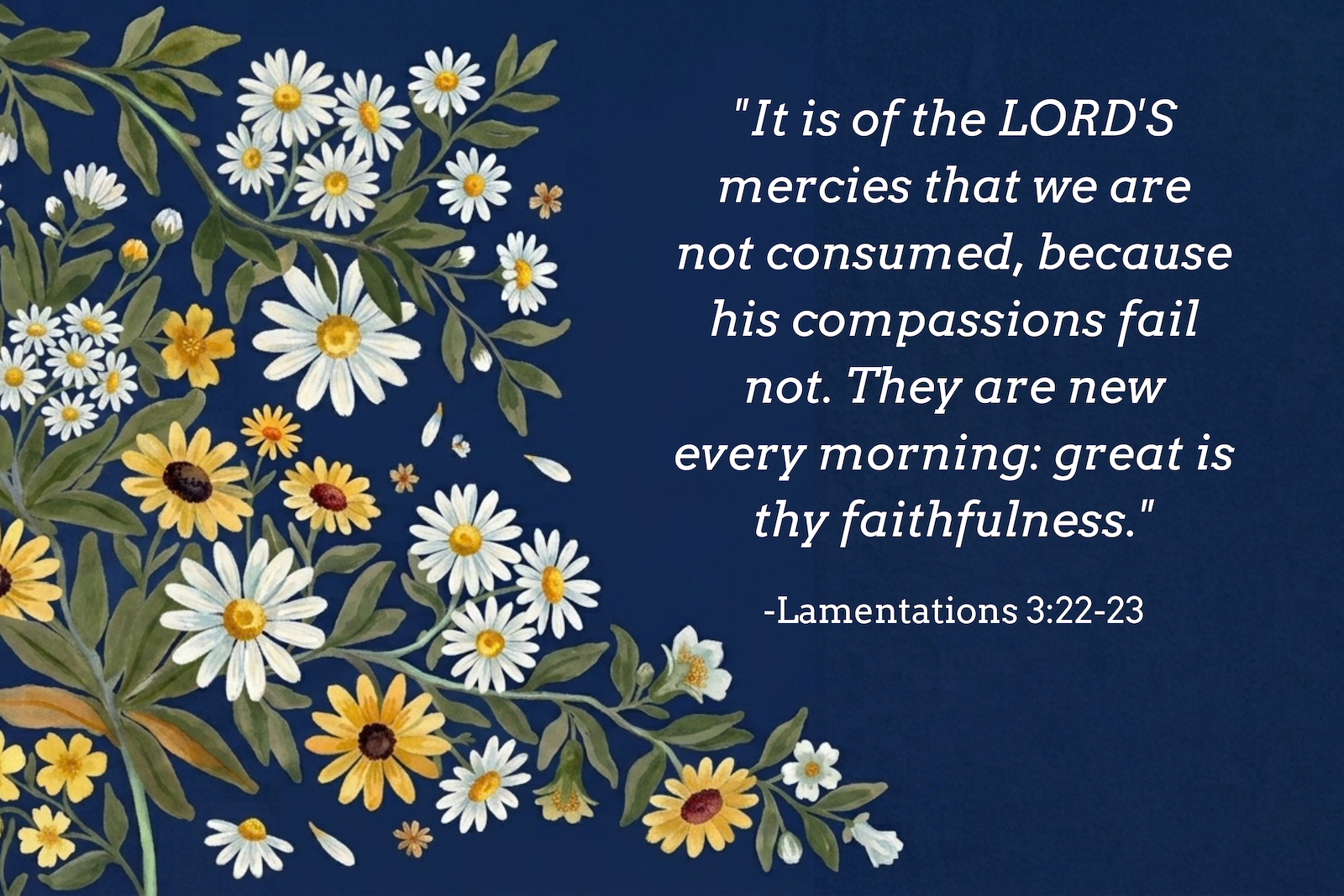
1. Lamentations 3:22-23: Faithfulness That Shows Up Every Morning
“It is of the LORD’S mercies that we are not consumed, because his compassions fail not. They are new every morning: great is thy faithfulness.”
Background. Lamentations is a book of grief. It was written after the Babylonian army destroyed Jerusalem and the temple in 586 BC, an event that ended the kingdom of Judah and sent many of its people into exile. Tradition credits the prophet Jeremiah with the book, though the text itself does not name an author. You can read about that catastrophe in the Britannica article on the Babylonian Exile.
Chapter 3 is strange and moving. It opens with the writer describing his pain in blunt terms. He feels hunted, worn down, and shut out. Then, right in the middle of the chapter, the tone turns. He says something like, I remember this, and therefore I have hope. Verses 22 and 23 are that turn. They were not written from a place of relief. They were written in the rubble.
Modern application. This is probably the most quoted verse on the subject, and it is often printed on mugs and wall art. It is worth remembering that the person who wrote it had lost almost everything. That changes how it reads. The verse does not say that bad things never happen. It says that after the worst day, there is still a morning, and God’s care has not run out overnight.
For a lot of people, the hardest part of a long trial is that every day feels like the same day. This verse gives a different way to count. You are not asked to find enough strength for the whole year. You are asked to receive what is given for today. Many people find it helpful to read these two verses at the start of the day, especially in a season when waking up feels heavy.
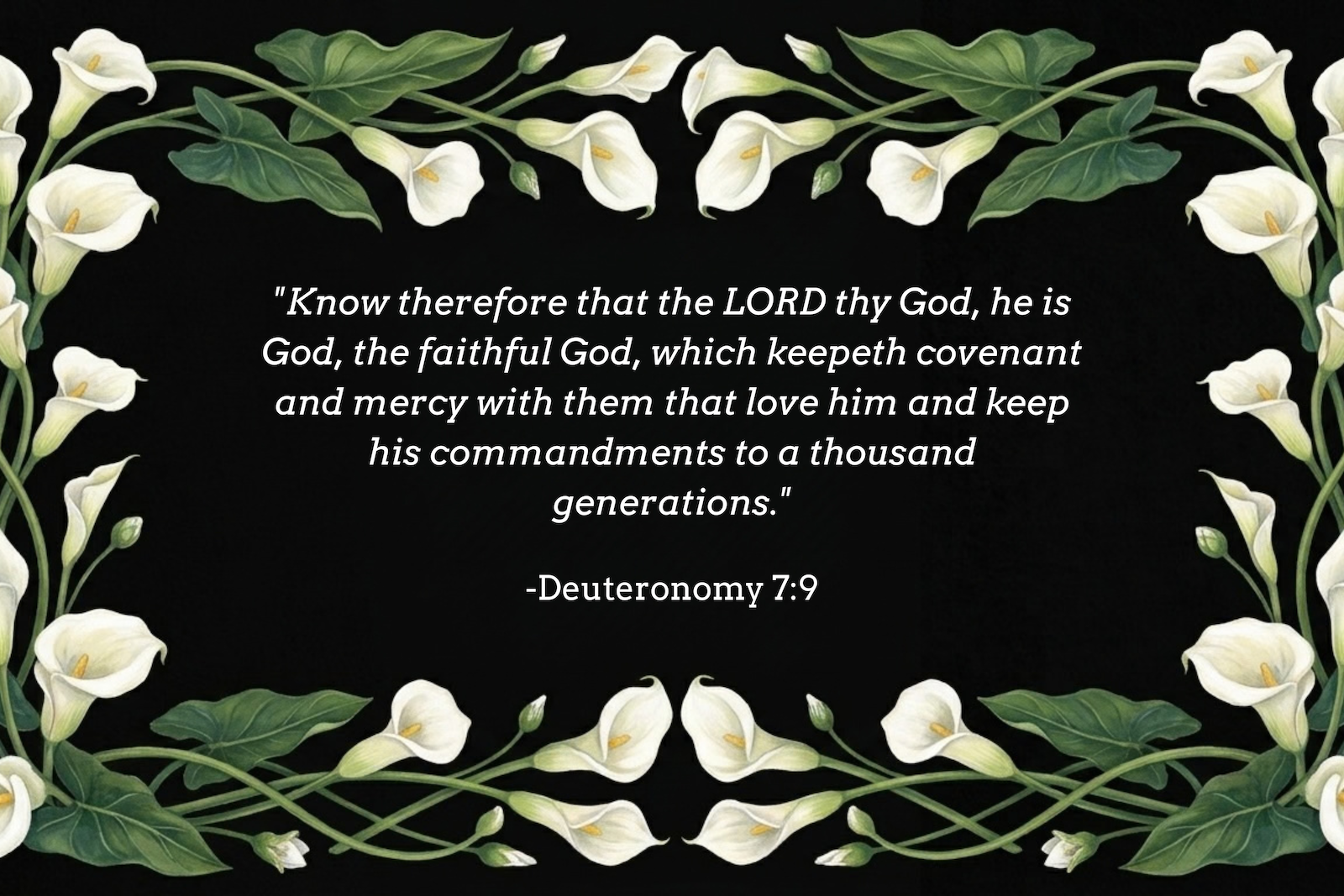
2. Deuteronomy 7:9: A Thousand Generations
“Know therefore that the LORD thy God, he is God, the faithful God, which keepeth covenant and mercy with them that love him and keep his commandments to a thousand generations.”
Background. Deuteronomy is mostly a series of speeches by Moses. He is old, he knows he will not cross into the Promised Land, and he is speaking to a new generation. Their parents had come out of Egypt but died in the wilderness after refusing to trust God at a key moment. The people standing in front of Moses had grown up with that failure in their family story.
So Moses reminds them who they are dealing with. In this chapter he has just told them they were not chosen because they were large or impressive. In fact, he says they were the smallest of nations. They were chosen because of God’s love and because of the oath he had made to their ancestors. Verse 9 is the conclusion. Since God keeps his word, they can know him as the faithful God.
Modern application. The phrase “a thousand generations” is about long memory. Most of us live in short cycles, checking our phones, tracking this quarter, worrying about next month. Deuteronomy asks us to zoom out. God’s promises were not made for one afternoon.
There is a personal side to this too. Many believers find that their faith was handed down by a parent, a grandparent, or a church that prayed for them before they could pray for themselves. Looking back at that chain can be steadying. You are standing on something that was built before you arrived. And if you are a parent or mentor, the verse gives you a reason to keep planting seeds even when you cannot see results.
3. Numbers 23:19: God Does Not Break His Word
“God is not a man, that he should lie; neither the son of man, that he should repent: hath he said, and shall he not do it? or hath he spoken, and shall he not make it good?”
Background. This verse comes from one of the odder stories in the Bible. Israel is camped near the border of Moab, and the Moabite king, Balak, is afraid of them. He hires a famous seer named Balaam to curse the Israelites. Balaam goes up on a hilltop, builds altars, and tries to speak against them. Each time, he can only speak blessings instead. In the second oracle, he states the principle in verse 19.
The point is striking. Balaam was a paid outsider with no loyalty to Israel, and even he was forced to admit that God does not change his mind the way a person does. A king could not buy a different answer.
Modern application. Human promises are fragile. People mean well and still forget, change course, or get overwhelmed. Most of us have been let down by someone we trusted, and that experience can make it hard to believe any promise is safe, including God’s.
This verse draws a clear line. God is not a man in the sense that he does not speak carelessly. When he says something, it stands. That does not mean we always understand how or when a promise will be fulfilled. It does mean the problem will never be on God’s end of the line. If you carry old wounds from broken promises, this is a verse to read slowly, and perhaps to bring up with a pastor or counselor who can help you separate what people did to you from who God is.
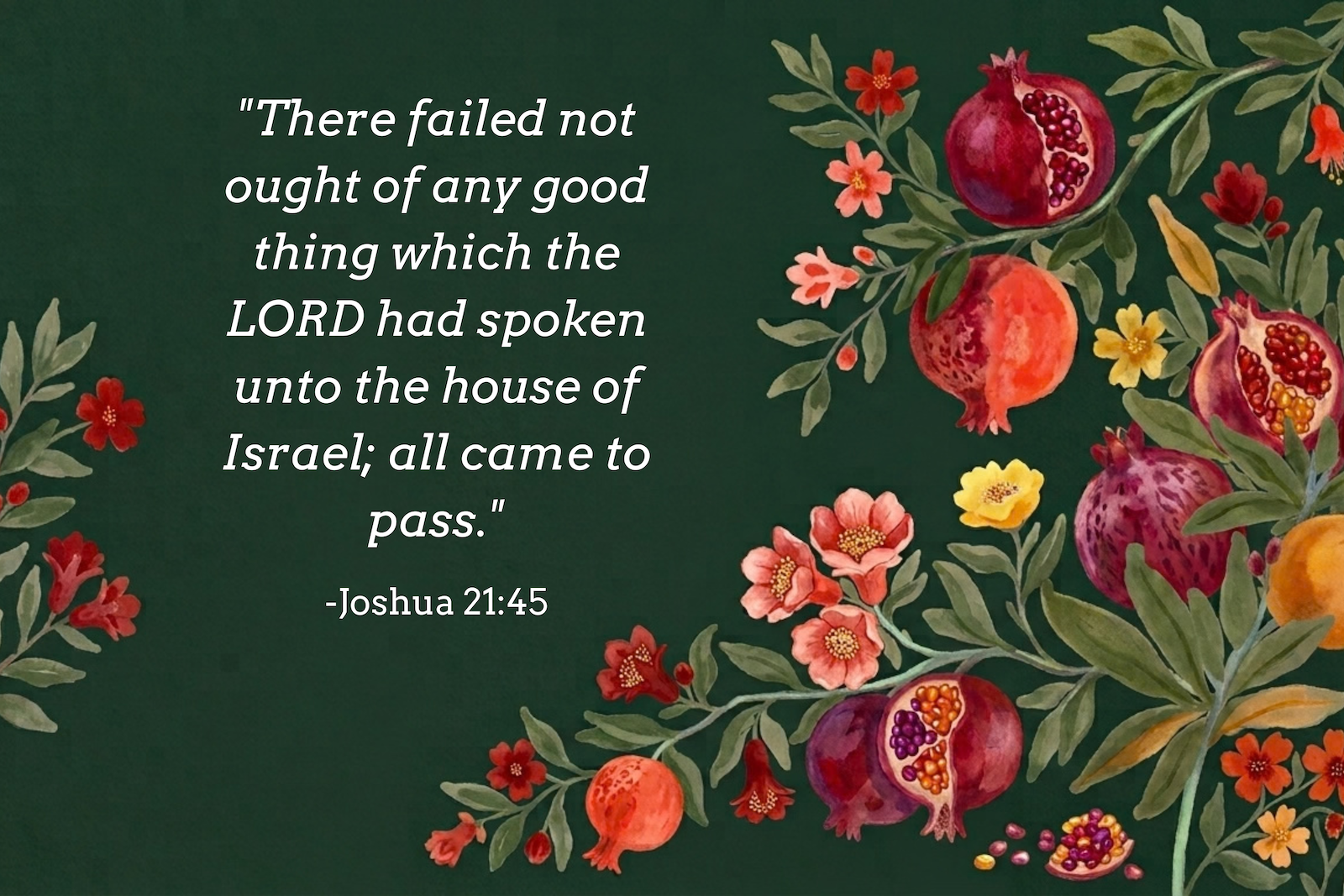
4. Joshua 21:45: Not One Promise Failed
“There failed not ought of any good thing which the LORD had spoken unto the house of Israel; all came to pass.”
Background. This is the quiet conclusion to a long story. For centuries the descendants of Abraham had been told they would receive a land. They had lived as slaves, wandered for forty years, and fought through the conquest under Joshua. At this point in the book, the tribes have settled and the Levites have been given their towns. The narrator steps back and gives a one-sentence summary of everything that came before.
It is a modest verse. There is no thunder or celebration here. It simply reads like a report: what was said happened. A similar line appears in Solomon’s prayer at the temple dedication, in 1 Kings 8:56, which says that not one word of God’s good promise had failed.
Modern application. Notice that this verse looks backward. It is a testimony written after the fact. That is one of the healthiest habits a person of faith can build, which is to keep a record of what God has already done.
Some people keep a journal of answered prayers. Others write down moments when help came unexpectedly. When fear is loud, that record becomes a counterweight. It does not make the present problem smaller, but it reminds you of what is true about the one you are praying to. If you are in a waiting season, consider writing your own version of Joshua 21:45 for the past ten years of your life. You may be surprised how much is on the list.
5. Psalm 36:5: Faithfulness as Big as the Sky
“Thy mercy, O LORD, is in the heavens; and thy faithfulness reacheth unto the clouds.”
Background. Psalm 36 is attributed to David, and it opens with a hard look at people who live as if God does not matter. David describes how they plan wrongdoing even in bed. Then, in verse 5, the psalm suddenly lifts its eyes. After the narrow picture of human scheming, he looks up and describes God’s love and faithfulness in terms of sky and mountains and the deep ocean.
The structure is deliberate. David does not ignore evil. He names it plainly and then sets it next to something far larger.
Modern application. News feeds, social media, and workplace politics can shrink our view until the problem feels like the whole world. This psalm models a different habit. You can name what is wrong without being swallowed by it, and then you deliberately lift your attention to something bigger.
A simple practice that comes from this: go outside, look at the sky, and read verse 5 aloud. It sounds almost too easy, but a lot of people find that changing what they look at changes how they breathe. The verse also gives language for gratitude. Faithfulness that reaches the clouds is not something you can use up.
6. Psalm 89:1: A Song You Pass On
“I will sing of the mercies of the LORD for ever: with my mouth will I make known thy faithfulness to all generations.”
Background. Psalm 89 is credited to Ethan the Ezrahite, and its setting is complicated. The first part celebrates God’s promise to David that his dynasty would last. The second half of the psalm turns painful. The writer sees the Davidic throne in ruins and asks why God seems to have rejected his anointed king. The psalm ends without a neat resolution.
That context makes verse 1 more interesting. The writer chooses to sing about faithfulness before he lays out his complaint. He is not pretending things are fine. He is anchoring himself to what he knows about God before he voices his confusion.
Modern application. There is real permission in this psalm for honest prayer. You can praise and question in the same breath. Many people feel guilty for bringing doubts to God, as if faith requires a tidy mind. Psalm 89 shows that doubt and worship can sit in the same song.
The second half of the verse, about making God’s faithfulness known to all generations, is a practical call. Tell your kids and your friends what God has done in your life. You do not need a polished speech. A short, honest story told at the dinner table often does more than a sermon, because the listener can see that it is real.
7. Psalm 119:90: Faithfulness You Can Walk On
“Thy faithfulness is unto all generations: thou hast established the earth, and it abideth.”
Background. Psalm 119 is the longest chapter in the Bible, with 176 verses. It is built as an acrostic. The psalm has 22 sections, one for each letter of the Hebrew alphabet, and every verse in a section begins with that letter. Almost every line is about God’s word, whether it is called law, testimony, precept, or statute.
Verse 90 sits in the lamed section, which begins with the declaration that God’s word is settled forever in heaven. The writer then makes a comparison. The earth stays in place because God set it there, and God’s faithfulness is just as dependable as the ground.
Modern application. There is a quiet comfort in the ground under your feet. You do not think about it until an earthquake or a landslide reminds you it is not guaranteed. The psalmist uses that everyday trust to describe something spiritual. If you can rely on the earth to be there when you step out of bed, you can rely on God’s character.
For people who feel unstable because of finances, health, or relationships, it can help to name what has not moved. Seasons still arrive, the sun still rises, and the sky is still above you. Let those ordinary things be small reminders that the world is held together by something steady.
8. Isaiah 25:1: Plans Made Long Ago
“O LORD, thou art my God; I will exalt thee, I will praise thy name; for thou hast done wonderful things; thy counsels of old are faithfulness and truth.”
Background. Isaiah 25 belongs to a section of the book, chapters 24 through 27, that scholars sometimes call the Isaiah Apocalypse. These chapters describe God’s judgment on the earth and his eventual victory. Chapter 25 is a song of praise sung after the dust settles. It is written for people who are living in a dangerous political world. Assyria was a threat during Isaiah’s lifetime, and Babylon would be a threat later.
The phrase “counsels of old” points to plans God made long before the current crisis. The prophet’s argument is that nothing is a surprise to God and that his long-term purposes are still moving forward, even when empires rise and fall.
Modern application. A lot of anxiety comes from the feeling that nobody is in charge. We read headlines and wonder how it will all hold together. Isaiah’s answer is that God’s plans were laid long ago and they are marked by faithfulness and truth.
That does not mean we sit back and do nothing. It means we can act without panic. A nurse, a teacher, a small business owner, or a parent can do a faithful day’s work without believing the whole world rests on their shoulders. If you are carrying more responsibility than you can handle, this verse offers a way to put down the part that was never yours to carry.
9. 1 Corinthians 1:9: Called by Someone Who Keeps His Word
“God is faithful, by whom ye were called unto the fellowship of his Son Jesus Christ our Lord.”
Background. Paul wrote 1 Corinthians from Ephesus around AD 53 to 55. The church in Corinth was a mess. It was in a large, wealthy port city known for trade and for loose morals, and the believers there were divided into factions, tolerating serious sexual immorality, suing one another, and arguing about spiritual gifts.
Yet Paul opens the letter by thanking God for them. In the verses leading up to verse 9, he says that God will keep them strong until the end. His reasoning is not that the Corinthians are impressive. His reasoning is that God is faithful. The call came from God, and God finishes what he starts.
Modern application. If the Corinthians could be held by God’s faithfulness, so can we. Many sincere Christians quietly worry that they are too inconsistent, too doubtful, or too far behind everyone else at church. Paul’s introduction suggests that the church has never been a gathering of finished people.
This verse shifts the question from “Am I good enough?” to “Who called me?” You do not hold yourself together by effort alone. The relationship rests on God’s commitment, and that is a far more stable foundation than your mood on a given Sunday.
10. 1 Corinthians 10:13: A Way Out
“There hath no temptation taken you but such as is common to man: but God is faithful, who will not suffer you to be tempted above that ye are able; but will with the temptation also make a way to escape, that ye may be able to bear it.”
Background. In chapter 10, Paul is recalling the story of Israel in the wilderness. He lists their failures: idolatry, sexual sin, testing God, and grumbling. He says these things were written down as warnings. Then comes verse 13, which is both a comfort and a challenge.
The comfort is that temptation is common. Nobody is facing something totally unique, and nobody is facing something God has not accounted for. The challenge is the promise of a way out, which implies that people are expected to look for it and take it.
Modern application. This verse is often misused. Some people read it as “God will never give you more than you can handle,” and then feel crushed when life clearly does overwhelm them. Read carefully, the verse is about temptation, not about every kind of suffering. It promises that God will provide an exit when we are pushed toward wrongdoing.
In practice, the exit can look very ordinary. It might be a friend you can text before you make a bad decision, a phone call, a boundary you set ahead of time, a trusted person who holds you accountable, or simply leaving the room. People who struggle with addiction, anger, or compulsive habits often say that the way out was there, but they only saw it when they stopped trying to fight alone. The verse also reminds us that shame thrives in secrecy, and that “common to man” means you are not the only one.
11. 2 Thessalonians 3:3: Protection for People Under Pressure
“But the Lord is faithful, who shall stablish you, and keep you from evil.”
Background. The believers in Thessalonica had been Christians for only a short time when Paul, Silas, and Timothy wrote to them, probably around AD 51 or 52. They were facing opposition from neighbors, and the second letter shows that they were also confused about teachings regarding the return of Christ.
In chapter 3, Paul asks them to pray for him and his team, since not everyone welcomes the message. Then he pivots. Not everyone has faith, he says, but the Lord is faithful. The word translated “stablish” means to make firm or to strengthen, so the picture is God putting a steady floor under shaky people.
Modern application. Many of us live under a quiet form of pressure that comes from a coworker, a family member, or a culture that treats faith as an oddity. You may feel pushed to stay quiet about what you believe or pushed to compromise it.
Paul’s reminder fits that experience. When other people are unreliable, God is not. The verse does not promise a life without opposition. It promises that you will be strengthened and guarded inside it. This is a good verse to memorize for a difficult conversation, a tense meeting, or a night when you cannot sleep because of work stress.
12. 1 John 1:9: Faithful to Forgive
“If we confess our sins, he is faithful and just to forgive us our sins, and to cleanse us from all unrighteousness.”
Background. The apostle John wrote this letter late in life, probably near the end of the first century. He was writing to churches troubled by teachers who denied important truths about Jesus and who also claimed that sin was not a real problem for them. John pushes back on both errors. He says that anyone who claims to be without sin is self-deceived, and that anyone who confesses will find forgiveness.
The word pairing “faithful and just” is interesting. Forgiveness here is not framed as God ignoring the rules. Because of what Christians believe Jesus accomplished, God can forgive without compromising justice, and he does so because he has promised to.
Modern application. Guilt can follow a person for decades. Some people replay a mistake from twenty years ago, and others feel that a recent failure has disqualified them from prayer. This verse says that forgiveness depends on God’s faithfulness and not on how well we perform after we confess.
That is worth sitting with. If forgiveness depended on us never repeating the failure, none of us would have any. Instead, it rests on God’s character. This does not make sin casual. Confession is still honest and often costly. But it does mean the door is open, and you can walk back through it as many times as you need to.
13. Hebrews 10:23: Holding On Without Wavering
“Let us hold fast the profession of our faith without wavering; (for he is faithful that promised;)”
Background. The book of Hebrews was written to Jewish Christians who were tempted to retreat. Life as followers of Jesus had cost them reputation, property, and in some cases freedom. Going back to the familiar patterns of Judaism would have been safer. The unnamed author spends the entire letter arguing that Jesus is greater than every earlier institution, and then he calls the readers to stay put.
Verse 23 is the practical heart of that call. The command is to hold on. The reason is in the parenthesis: the one who promised is faithful. The strength of your grip is not the point. The reliability of the promiser is.
Modern application. Spiritual endurance is not about gritting your teeth. It is about remembering who is holding the rope. Hebrews goes on, in the verses right after this one, to encourage believers to meet together and to stir one another up. That is a useful reminder that holding on is a shared project.
If you feel like your faith is slipping, you may not need a dramatic experience. You may need a faithful friend, a small group, or a church that will sit beside you. The verse makes room for people who are tired. You are not asked to hold on by yourself, and you are not holding on to a flimsy thing.
14. 2 Timothy 2:13: Faithful Even When We Are Not
“If we believe not, yet he abideth faithful: he cannot deny himself.”
Background. Second Timothy is Paul’s last letter, written from a Roman prison. He knows his execution is likely. He is writing to Timothy, his younger co-worker, who is timid and facing pressure. In chapter 2, Paul quotes what many scholars think is an early hymn or confession. The lines move from “if we die with him, we shall also live with him” to “if we deny him, he also will deny us,” and then to verse 13.
The final line is the surprise. After a series of conditional statements, Paul says that even when we are faithless, God stays faithful, because being faithless would contradict who he is.
Modern application. This is a verse for people in a dry season. You might be going through a stretch where prayer feels empty, you doubt things you used to be sure of, or you have drifted. It is common, and many long-time believers describe periods like this.
The verse does not excuse unbelief, and it sits next to warnings that take denial seriously. But it also says that your wavering does not change God’s character. If you are afraid that your doubt has pushed God away, this is one of the most reassuring passages in the Bible. The relationship does not collapse because of a hard season. The one who holds it together is not you.
Bonus: Faithful and True
It is worth noting that in Revelation 19:11, the rider on the white horse is called “Faithful and True.” Faithfulness is not just something God does. In the final book of the Bible, it becomes part of his name. The story that began with promises made to Abraham ends with a title that says the promises were kept.
How Belief in God Helps Us During Challenging Times
Scripture about God’s faithfulness is not meant to stay on the page. It is meant to be lived in. So how does belief in God actually help when life gets hard? Here are some honest, practical ways, along with a few cautions.
It gives you a place to bring the pain
One of the most overlooked features of the Bible is how much of it is complaint. About a third of the Psalms are laments. People cry out, accuse, and plead. Faith in the Bible is not the same as pretending to be fine. It is bringing your whole self, including your anger and confusion, to someone you believe is listening.
That matters because suffering gets heavier when it is held in silence. Prayer, for believers, is a way of speaking the truth out loud to someone who can handle it. Even people who struggle to believe often say that the act of praying honestly gives them some relief.
It offers presence, not just answers
Isaiah 43:2 says, “When thou passest through the waters, I will be with thee; and through the rivers, they shall not overflow thee: when thou walkest through the fire, thou shalt not be burned; neither shall the flame kindle upon thee.” Notice what the promise is. It does not say you will avoid the water or the fire. It says you will pass through them, and that you will not go alone.
Psalm 46:1 says that God is “a very present help in trouble.” The word “present” is key. Many people in hard seasons report that what they needed most was not an explanation but company. Belief in a God who is near can provide that sense of company even in a hospital room at three in the morning.
It supplies a larger story
Trials can make life feel random. A belief in God’s faithfulness offers a frame in which your pain is not the final word. The Bible does not claim that every hardship is secretly a good thing. Death, abuse, and injustice are treated as real evils. What it claims is that God is working to redeem and restore, and that suffering will not have the last say.
The story of Joseph in Genesis is a well-known example. Sold by his brothers, falsely accused, and forgotten in prison, he eventually rose to a position where he could save many lives. When he spoke to his brothers years later, he said that what they meant for evil, God meant for good (Genesis 50:20). He did not say the betrayal was good. He said God brought something good out of it. That distinction is important, and it helps people avoid the cruel idea that every bad event happens for a reason that makes it okay.
It connects you to a community
Faith is rarely a solo project. Churches, small groups, and friendships grounded in shared belief often become the practical hands of God’s care. People bring meals, sit with the grieving, and drive each other to appointments. When Hebrews 10:23 is followed by an encouragement to meet together, that is not an accident.
Research on religion and well-being often notes the role of community in the benefits people report. The Pew Research Center’s religion section publishes ongoing data on how people in the United States practice and experience faith, and it is a useful place to see how belief and social connection overlap.
It builds endurance through hope
Paul writes in Philippians 1:6 that “he which hath begun a good work in you will perform it until the day of Jesus Christ.” For many believers, hope of this kind is a practical resource. Hope makes it easier to get out of bed, to keep showing up at work, and to keep loving people who are difficult to love. It is not a feeling that you manufacture. It grows as you remember what God has done and trust what he has promised.
A few honest cautions
Faith can be a real comfort, but it is worth being careful about how it is used.
First, faith does not replace professional help. If you are dealing with depression, anxiety, trauma, or grief that will not lift, please see a doctor or licensed counselor, and keep praying too. Many pastors strongly encourage this. The National Institute of Mental Health has a page that helps people find mental health support.
Second, be careful with people who offer quick spiritual answers to deep pain. Lines like “everything happens for a reason” can do harm when said to someone who is grieving. The book of Job is a good model here. Job’s friends were at their best when they sat in silence with him and at their worst when they started explaining his suffering.
Third, waiting is hard, and the Bible does not hide that. Some prayers go unanswered for a long time, and some are answered in ways we did not expect. Faithfulness does not mean that God does what we ask on our schedule. It means he can be trusted with the outcome, even when we cannot see it yet.
How to Apply These Verses Day to Day
Reading scripture about God’s faithfulness is helpful, but it works best when it becomes a habit. Here are a few simple ways to carry these verses into your week.
Pick one verse and stay with it.
Instead of reading all 14 in one sitting, choose one that matches your season and read it every morning for a week. Write it on a card and put it where you will see it.
Keep a faithfulness journal.
Take five minutes at night to write down one way you noticed God’s care that day. It can be small, like an unexpected phone call or a quiet moment of peace. Over a few months you will have your own version of Joshua 21:45.
Read the context.
Every verse in this post has a story around it. Open your Bible and read the full chapter. A free tool like Bible Gateway lets you look at multiple translations at once, which can make an unfamiliar passage clearer.
Share your story.
Psalm 89:1 talks about making God’s faithfulness known to all generations. You might tell a friend, a child, or a small group about a time God came through. A short, honest account can encourage someone more than you realize.
Pray the verses back.
Turn a verse into a prayer. For example, with 2 Thessalonians 3:3, you could say, “Lord, you are faithful. Strengthen me today and keep me from evil.” It is simple and it keeps your attention on God instead of on the problem.
Find a community.
If you do not have a church or small group, consider visiting a few. Hebrews 10:23-25 treats shared faith as a source of strength.
Frequently Asked Questions About God’s Faithfulness
What is the best Bible verse about God’s faithfulness?
There is no single answer, but Lamentations 3:22-23 is among the most loved. It says that God’s compassions never fail and that they are new every morning. Many people also turn to Deuteronomy 7:9, 1 Corinthians 10:13, and 2 Timothy 2:13 depending on what they are facing.
Does the Bible say God is always faithful?
Yes. Passages across both testaments describe God as faithful, including Deuteronomy 7:9, Psalm 89:1, 1 Corinthians 1:9, and Hebrews 10:23. Second Timothy 2:13 goes further by saying that God remains faithful even when people are not.
How can I trust God’s faithfulness when my prayers feel unanswered?
This is one of the most common struggles in faith. The Psalms are full of people asking the same question, and they were not rebuked for asking. You can bring that honesty to God in prayer. It can also help to look back at what God has done in your past, to talk with a trusted pastor or friend, and to get professional support if you are in deep distress.
What is the difference between God’s faithfulness and God’s love?
They are closely connected in the Bible. Faithfulness is about God’s reliability and keeping his promises. Love, often expressed as the Hebrew word hesed, is about the warmth and mercy behind that reliability. The Psalms often mention them together, as in Psalm 36:5.
Is “God will not give you more than you can handle” in the Bible?
Not in those words. People often connect it to 1 Corinthians 10:13, but that verse is specifically about temptation and the promise of a way out. The Bible acknowledges that people can be overwhelmed by suffering, as in 2 Corinthians 1:8, where Paul says he and his companions were under pressure beyond their strength. The comfort in scripture is that God is present, not that we never feel overwhelmed.
How do I teach children about God’s faithfulness?
Stories work well. Tell them about Noah, Joseph, or Daniel, and then connect those stories to simple moments in your own family when you saw God help. Memorizing a short verse together, like Psalm 36:5 or 2 Thessalonians 3:3, can also give kids something to hold onto as they grow.
Final Thoughts
The Bible’s message about God’s faithfulness is not abstract. It was written by people who lived through war, exile, prison, betrayal, and failure. They kept writing about God’s steady character because they had tested it in the hardest places.
If you are in a season where you need that reminder, start small. Read one verse today. Look up the story around it. Say it out loud, or write it down. The faithfulness of God is not something you have to build. It is something you can lean on, and the ground that was holding the writers of these verses is the same ground that is under you now.
For further study, the Blue Letter Bible offers free commentaries and original language tools, and Bible Gateway is helpful for reading in multiple translations. If you are going through something heavy right now, please reach out to someone you trust, whether that is a pastor, a counselor, or a friend. You were not meant to carry it by yourself.