12 Fruits of the Holy Spirit PDF: A Free Download for Sunday School
If you’ve ever tried to explain the Holy Spirit to a room full of wiggly six-year-olds, you know the challenge: how do you make something so profound feel real and relatable to kids? One of the best ways is through the Fruits of the Holy Spirit for kids— the visible, everyday qualities that show the Spirit is at work in someone’s life.
In this post, we’ll walk through all 12 fruits, share simple explanations you can use with children, and give you ideas for turning this list into a printable handout for your Sunday school classroom.
Where Do the 12 Fruits Come From?
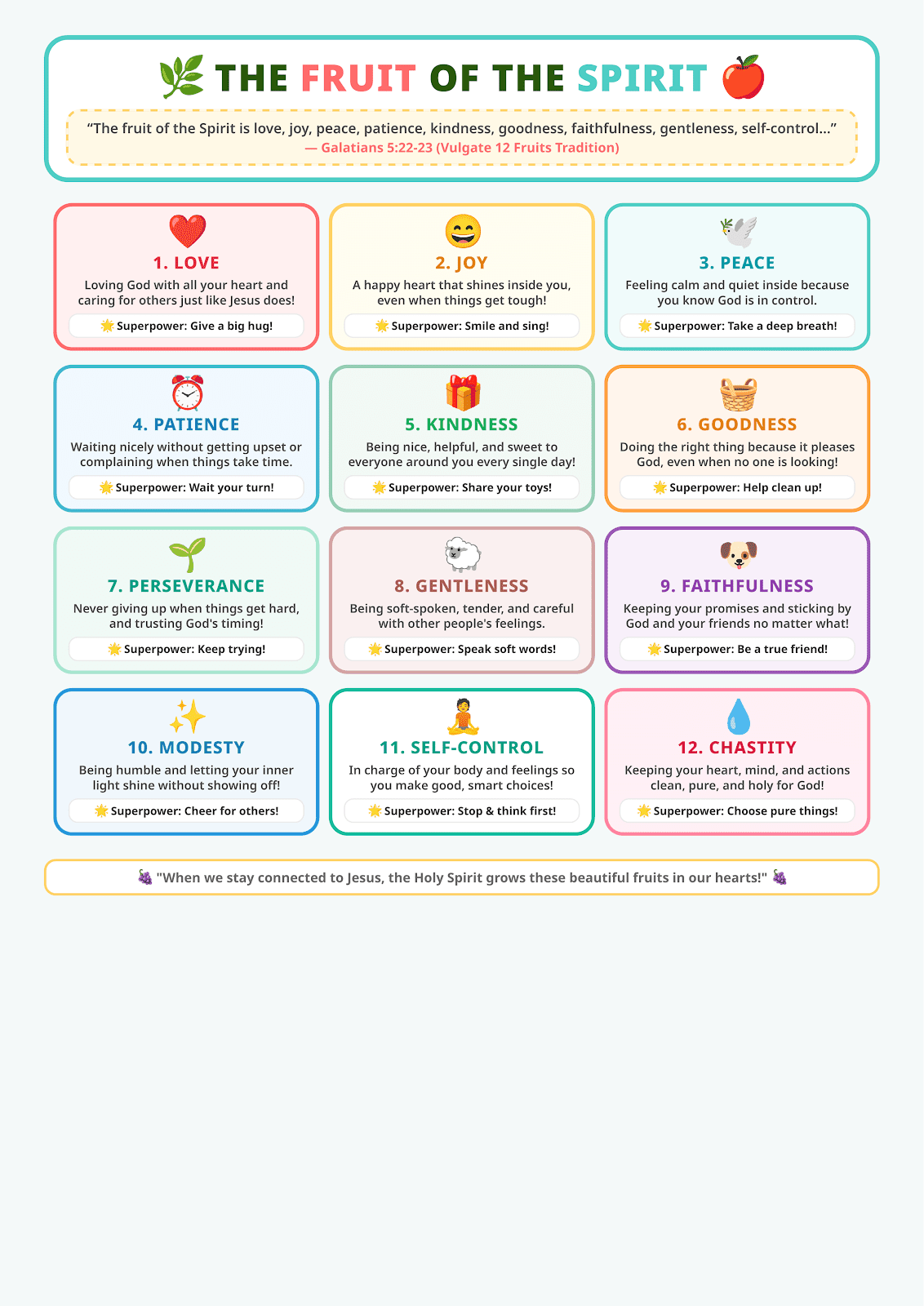
The fruits of the Holy Spirit trace back to Galatians 5:22-23, where the apostle Paul contrasts the “works of the flesh” with the “fruit of the Spirit.” In the Vulgate (Latin) version of this passage, and in Catholic tradition, the list expands to twelve qualities rather than the nine most commonly cited in Protestant traditions. Both lists describe the same basic idea: when someone lives close to God, their character naturally produces good “fruit” — just like a healthy tree produces good fruit without straining.
For Sunday school purposes, the 12-fruit list gives teachers more material to work with and more chances for kids to find a quality that resonates with them personally.
The 12 Fruits of the Holy Spirit, Explained for Kids
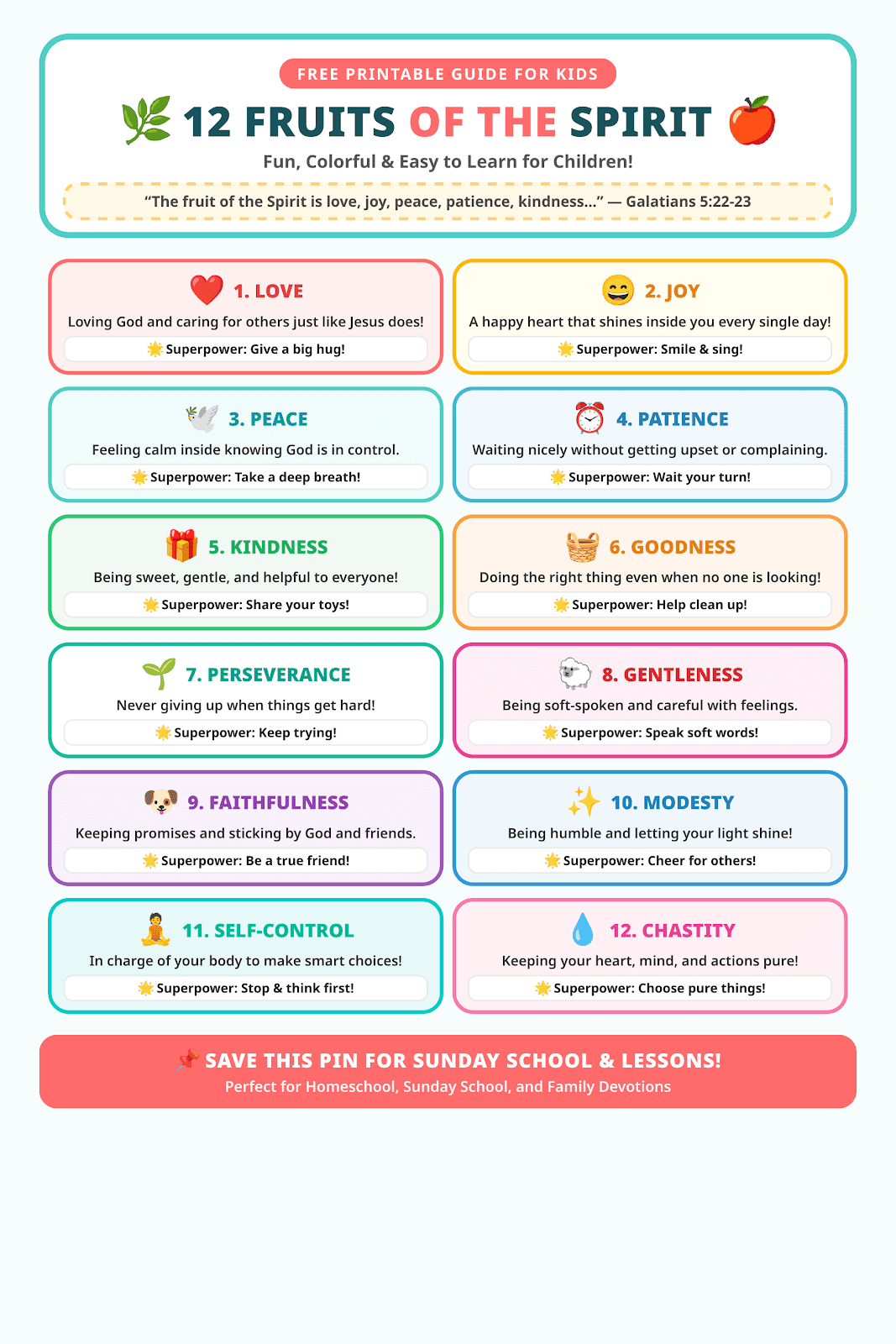
- Charity (Love) — Caring about others and putting their needs alongside your own.
- Joy — A deep happiness that doesn’t depend on what’s happening around you.
- Peace — Feeling calm and safe inside, even during hard moments.
- Patience — Waiting without getting frustrated or giving up.
- Kindness — Being gentle and helpful to the people around you.
- Goodness — Choosing to do what’s right, even when no one is watching.
- Generosity — Sharing freely with others, without keeping score.
- Gentleness — Being soft-spoken and careful with people’s feelings.
- Faithfulness — Keeping your promises and being someone others can count on.
- Modesty — Not showing off or bragging about yourself.
- Self-Control — Choosing to do the right thing even when your feelings say otherwise.
- Chastity — Keeping your thoughts, words, and actions pure and respectful.
Each of these can be tied to a simple, real-life example: sharing a toy (generosity), saying sorry first (peace), or waiting your turn in line (patience). Kids grasp abstract virtues much faster when they’re anchored to something they’ve actually experienced.
Download this PDF for free!
Why a Printable Handout Works So Well
Sunday school teachers know that hands-on materials make lessons stick. A printable PDF listing the 12 fruits gives you:
- A take-home reminder. Kids can tape it to the fridge or keep it in a Bible.
- A coloring or matching activity. Younger children can match each fruit to a simple picture or scenario.
- A discussion starter. Older kids can circle the fruit they want to practice that week.
- A memory verse companion. Pair the list with Galatians 5:22-23 for scripture memorization.
Ideas for Building Your Own Free PDF
If you’d like to put together a printable for your class in a program such as Canva, here’s a simple structure that works well:
- Page 1: Title, memory verse (Galatians 5:22-23), and a tree illustration with 12 “fruits” hanging from the branches
- Page 2: The 12 fruits listed with kid-friendly definitions (like the ones above)
- Page 3: A blank tree template where kids can write or draw their own examples of each fruit
- Page 4: A simple weekly tracker — “Which fruit will you practice this week?”
You can design this yourself in any free tool (Canva, Google Docs, or even a Word template), or ask a designer in your church community to help polish it up. The goal isn’t a fancy design — it’s something clear, colorful, and easy for a child to hold onto.
Classroom Activity Ideas
Pair your printable with one or two of these activities to bring the lesson to life:
- Fruit basket relay: Write each fruit on a paper “fruit” and have kids race to place them in a basket while naming an example.
- Act it out: Split kids into small groups and have them act out a scenario demonstrating one fruit (without saying which one) while classmates guess.
- Fruit of the week: Choose one fruit to focus on each week and challenge kids to look for it in themselves and others.
- Gratitude circle: Have kids share a time someone showed them kindness, patience, or generosity.
Final Thoughts
Teaching the 12 Fruits of the Holy Spirit doesn’t have to be complicated. With a simple, well-designed printable and a few hands-on activities, you can help kids connect abstract spiritual concepts to their everyday choices — sharing, waiting patiently, telling the truth, and treating others with kindness.
Want help designing an actual printable PDF version of this list — with graphics, a coloring page, and a weekly tracker? Just ask, and it can be put together as a ready-to-print download for your classroom.