
Letting Go and Letting God: 30+ Bible Verses to Carry You Through Difficult Times

There’s a particular kind of exhaustion that comes from gripping too tightly to things we were never meant to carry alone — a diagnosis, a broken relationship, a financial fear, a decision we can’t undo. “Letting go and letting God” isn’t about giving up. It’s about releasing the illusion of control and placing our trust in a God who sees further than we can and carries more than we can.
Below are more than 30 Bible verses (King James Version) organized by the kind of struggle they speak to most directly — surrender and trust, anxiety and worry, peace in the storm, strength for the weary, and hope for the future. Read slowly. Let a few of them become the ones you return to.
A Time When I Had to Put Letting Go and Letting God Into Practice
When I decided to return to work after seven years at home raising my children, the sheer fear altering the kids’ schedules and changing family dynamics completely overwhelmed me. I spent weeks trying to control every detail, agonizing over how we would balance school drop-offs, work deadlines, and our daily routine.
Realizing that my tight grip was only breeding anxiety instead of peace, I finally took a deep breath, released my demand for perfection, and chose to trust that God would sustain us through the transition. Taking that leap meant accepting that the path might be messy, but I didn’t have to carry the burden of the unknown all on my own. Surrendering my need for control brought a quiet confidence that everything would unfold exactly as it was meant to.


Verses About Surrender and Trusting God With Control
When we’re used to solving our own problems, surrender can feel like weakness. Scripture reframes it as wisdom.
Proverbs 3:5-6 — “Trust in the LORD with all thine heart; and lean not unto thine own understanding. In all thy ways acknowledge him, and he shall direct thy paths.”
Proverbs 3:5-6 is basically telling us to trust God fully instead of leaning on our own limited view of things — and that kind of surrender isn’t about sitting back and doing nothing, it’s an active choice to loosen our grip on outcomes we can’t see coming anyway. The payoff — “he shall direct thy paths” — shows that letting go doesn’t leave you lost; you’re just trading your own steering for God’s, even though that means trusting a plan you can’t double-check ahead of time.
Psalm 37:5 — “Commit thy way unto the LORD; trust also in him; and he shall bring it to pass.”
Psalm 37:5 is all about making a choice — actually handing your plans and goals over to God — and then backing that choice up with real trust, not just words; and the promise that follows, “he shall bring it to pass,” gets at what surrender really means here: it’s not throwing in the towel on your dreams, it’s letting go of the exhausting job of forcing them to happen all by yourself.
Psalm 46:10 — “Be still, and know that I am God: I will be exalted among the heathen, I will be exalted in the earth.”
Psalm 46:10’s “be still” is basically God saying “stop trying to fix everything yourself for a second” — and it’s only in that pause, when we quit white-knuckling our own plans, that we actually get a real sense of just how big and in-control God is; that’s what makes it such a perfect surrender verse, since letting go isn’t about giving up, it’s about finally getting quiet enough to notice who’s really holding things together.
Proverbs 16:3 — “Commit thy works unto the LORD, and thy thoughts shall be established.”
Proverbs 16:3 is like saying “hand over whatever you’re working on — your projects, your goals, all of it — to God,” and the deal is that when you actually do that, your thoughts stop spinning in anxious circles and start feeling settled instead; it fits right in with the surrender theme because it shows that letting go of control isn’t about losing your grip on life, it’s what actually brings the peace of mind you were trying to force on your own.
James 4:7 — “Submit yourselves therefore to God. Resist the devil, and he will flee from you.”
James 4:7 pairs two moves that seem almost opposite — submitting to God while actively resisting the devil — showing that surrender isn’t just going limp and passive; it’s more like you plant yourself firmly under God’s authority first, and that’s exactly what gives you the strength to push back against stuff trying to pull you off track, which is the whole point of trusting-God-with-control verses: real surrender doesn’t leave you weak, it’s actually where your power to stand firm comes from.
Psalm 62:8 — “Trust in him at all times; ye people, pour out your heart before him: God is a refuge for us.”
Psalm 62:8 basically invites you to stop bottling everything up and just “pour out your heart” to God — no filter, no holding back, whatever’s actually going on — and calling him a “refuge” makes it clear this isn’t a one-time thing but an “at all times” kind of trust; it lines up perfectly with the surrender theme because it shows that giving up control isn’t scary when the one you’re handing it to is somewhere safe enough to dump all your mess on.
Isaiah 26:3 — “Thou wilt keep him in perfect peace, whose mind is stayed on thee: because he trusteth in thee.”
Isaiah 26:3 makes a pretty direct trade: keep your mind “stayed on” God — basically fixed on him instead of spiraling over everything you can’t control — and what you get back is “perfect peace,” which is the real payoff of trusting him; it fits right into the surrender theme because it shows peace isn’t something you find by gripping tighter to your own control, it’s what shows up once you finally loosen your hold and lock your focus on God instead.

Verses for Anxiety, Worry, and Fear
These are the verses to hold onto when your mind won’t stop racing.
Philippians 4:6-7 — “Be careful for nothing; but in every thing by prayer and supplication with thanksgiving let your requests be made known unto God. And the peace of God, which passeth all understanding, shall keep your hearts and minds through Christ Jesus.”
Philippians 4:6-7 basically says “don’t be anxious about anything” and instead take literally everything — through prayer, asking, and even being thankful in the middle of it — straight to God, and the payoff is a peace so far beyond normal logic (“which passeth all understanding”) that it just stands guard over your heart and mind. It’s a perfect fit for verses on anxiety and worry because it doesn’t just tell you to stop being scared, it hands you an actual move to make instead of just white-knuckling through the fear on your own.
1 Peter 5:7 — “Casting all your care upon him; for he careth for you.”
1 Peter 5:7 is short but hits hard — “casting” makes it sound like you’re literally chucking your worries onto God instead of carrying them yourself, and the reason that’s even an option is tucked right into the verse: “he careth for you,” meaning this isn’t dumping your problems on someone who doesn’t want them. It flips the whole logic of worry — you don’t have to prove you can handle it alone, you just have to trust that the one you’re handing it to actually cares.
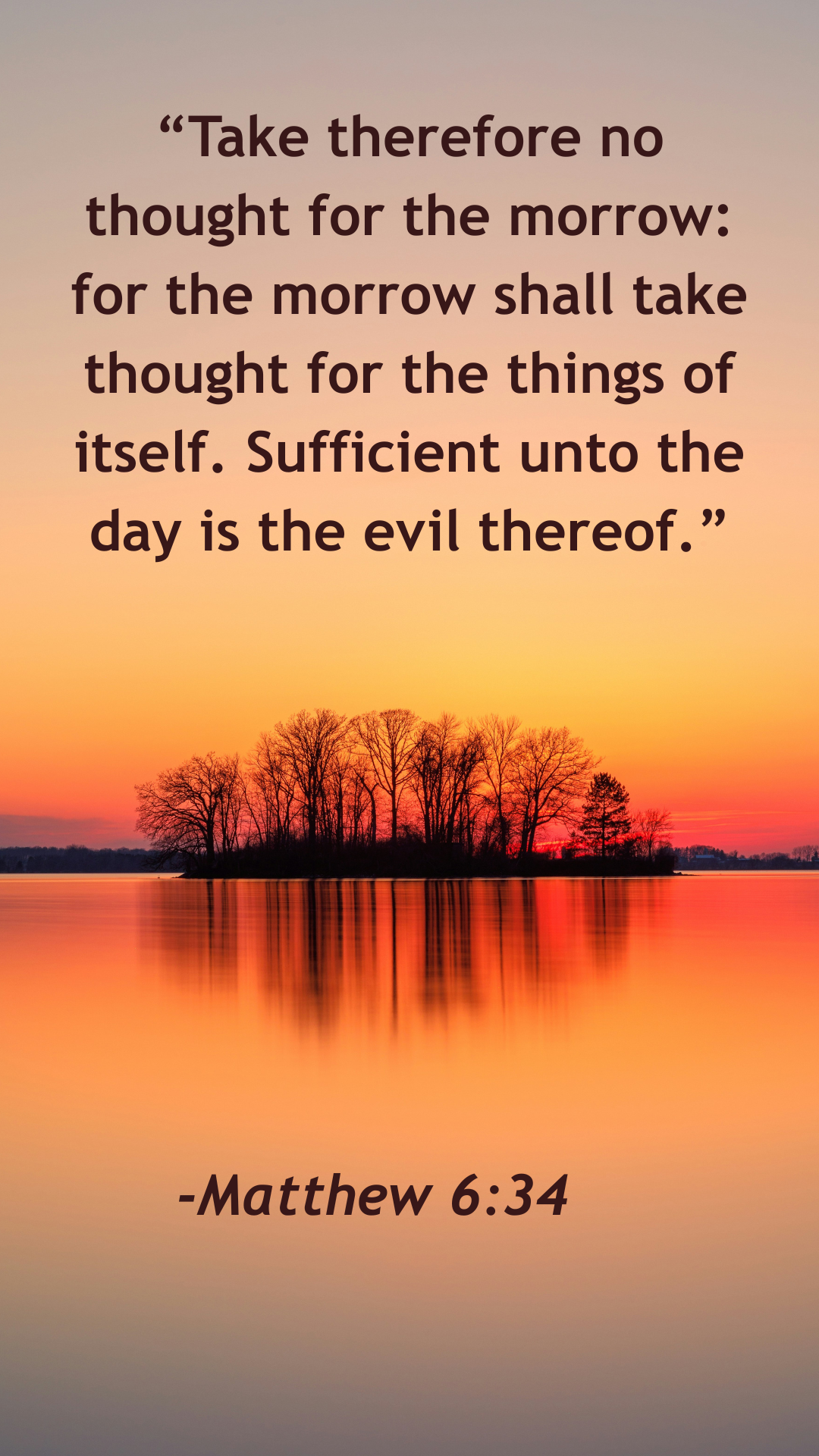
Matthew 6:34 — “Take therefore no thought for the morrow: for the morrow shall take thought for the things of itself. Sufficient unto the day is the evil thereof.”
Matthew 6:34 is Jesus saying “don’t borrow tomorrow’s problems today” — pointing out that tomorrow’s got its own stuff to deal with, and piling that on top of whatever you’re already handling today just doubles the weight for no reason. It’s such a solid anxiety verse because it calls out exactly how worry actually works — not staying present, but mentally living in a future that hasn’t even happened yet — and gives you permission to just deal with today, since that’s genuinely “sufficient” all on its own.
Psalm 55:22 — “Cast thy burden upon the LORD, and he shall sustain thee: he shall never suffer the righteous to be moved.”
Psalm 55:22 uses that same “cast” language — like physically throwing your burden off your own back and onto God’s — and backs it up with a double promise: he’ll “sustain” you through it, and he won’t let you be permanently shaken or “moved”. It’s a great verse because it’s honest that the weight is real and worth naming, while still pointing to steadiness on the other side of handing it over instead of just gritting your teeth and carrying it solo.
Isaiah 41:10 — “Fear thou not; for I am with thee: be not dismayed; for I am thy God: I will strengthen thee; yea, I will help thee; yea, I will uphold thee with the right hand of my righteousness.”
Isaiah 41:10 stacks up promise after promise — “I am with thee,” “I will strengthen thee,” “I will help thee,” “I will uphold thee” — like God’s making sure there’s no gap left for fear to sneak back in, and that pileup is exactly why it works so well as an anxiety verse. It doesn’t just say “don’t be scared,” it backs that command up with specific reasons rooted in who’s actually standing there with you, so the fear can loosen its grip because the answer to “what if I can’t handle this” is simply “you’re not doing it alone.”
Psalm 94:19 — “In the multitude of my thoughts within me thy comforts delight my soul.”
Psalm 94:19 is really relatable if you’ve ever laid awake with your brain running a hundred different worst-case scenarios — “the multitude of my thoughts” is basically anxious overthinking on repeat — but the turn in the verse is that right in the middle of all that mental noise, God’s comfort actually shows up and brings delight to the soul instead of just adding to the chaos. It doesn’t pretend the racing thoughts aren’t happening, it just shows that they don’t get the final word once God’s comfort steps in.
2 Timothy 1:7 — “For God hath not given us the spirit of fear; but of power, and of love, and of a sound mind.”
2 Timothy 1:7 draws a line and says fear was never part of the package God handed you — instead what you actually got was “power,” “love,” and “a sound mind,” like a total reversal of what anxiety tries to convince you is true about yourself. It doesn’t just tell you to stop being afraid, it reminds you that fear isn’t even your default setting — it’s something trying to crash a party it wasn’t invited to.


Verses for Peace in the Storm
When circumstances are chaotic, these verses point to a peace that doesn’t depend on circumstances at all.
John 14:27 — “Peace I leave with you, my peace I give unto you: not as the world giveth, give I unto you. Let not your heart be troubled, neither let it be afraid.”
John 14:27 makes a point of separating two kinds of peace — the shaky, circumstance-dependent kind “the world giveth,” versus the peace Jesus actually hands over, which doesn’t depend on things looking calm around you. It’s not promising the storm will vanish, it’s promising a peace steady enough to hold your heart together even while the storm’s still raging.
Psalm 23:1-4 — “The LORD is my shepherd; I shall not want. He maketh me to lie down in green pastures: he leadeth me beside the still waters. He restoreth my soul: he leadeth me in the paths of righteousness for his name’s sake. Yea, though I walk through the valley of the shadow of death, I will fear no evil: for thou art with me; thy rod and thy staff they comfort me.”
Psalm 23:1-4 paints God as a shepherd who doesn’t just show up after the storm — he’s the one leading you to “green pastures” and “still waters” for actual rest, restoring your soul before things even get hard, so that when you do hit the “valley of the shadow of death,” the fear doesn’t win, because “thou art with me” changes everything. It shows peace isn’t about the valley disappearing, it’s about having a shepherd whose presence and “rod and staff” are steady enough to comfort you the whole way through it.
Psalm 34:18 — “The LORD is nigh unto them that are of a broken heart; and saveth such as be of a contrite spirit.”
Psalm 34:18 flips the script on where you’d expect God to show up — instead of hanging back until you’ve got it together, he moves in close (“nigh”) precisely when you’re brokenhearted and crushed, no polished-up faith required. It shows God’s nearness isn’t something you earn by holding it together, it’s something that shows up strongest exactly when you can’t.
Nahum 1:7 — “The LORD is good, a strong hold in the day of trouble; and he knoweth them that trust in him.”
Nahum 1:7 packs in three big ideas back to back — God’s goodness, his role as a “strong hold” (basically a safe fortress) specifically “in the day of trouble,” and this personal detail that “he knoweth them that trust in him,” meaning it’s not some distant, generic promise. It doesn’t wait for the trouble to pass to talk about God’s strength — it names the storm directly and says that’s exactly where he’s a stronghold, and exactly where he knows you by name.
Psalm 27:1 — “The LORD is my light and my salvation; whom shall I fear? the LORD is the strength of my life; of whom shall I be afraid?”
Psalm 27:1 answers fear with two rhetorical questions instead of just a flat “don’t be afraid” — “whom shall I fear?” and “of whom shall I be afraid?” — and the logic works because God is named as “light” (cutting through the dark confusion of the storm) and “the strength of my life” (the actual source of stability). It doesn’t dodge the question of fear, it just makes the case that once you know who’s holding your light and your strength, the storm loses its power to actually scare you.
Colossians 3:15 — “And let the peace of God rule in your hearts, to the which also ye are called in one body; and be ye thankful.”
Colossians 3:15 uses this interesting word “rule” — like peace isn’t just supposed to visit your heart occasionally, it’s meant to actually take charge there, acting as the deciding vote when anxiety and chaos try to take over instead. It turns peace into something active rather than passive, and pairs it with gratitude, suggesting that staying thankful even mid-storm is part of what lets that peace keep its seat of authority in the first place.

Verses for Strength When You’re Weary
For the seasons when you feel like you have nothing left to give.
Isaiah 40:31 — “But they that wait upon the LORD shall renew their strength; they shall mount up with wings as eagles; they shall run, and not be weary; and they shall walk, and not faint.”
Isaiah 40:31 lays out this cool progression — soaring like eagles, then running without getting tired, then just walking without fainting — almost like it’s covering every speed of life, from the big dramatic moments down to the slow, grinding everyday ones. The strength doesn’t come from pushing harder on your own, it comes from “waiting upon the LORD,” which means sometimes fighting exhaustion actually looks like slowing down and trusting instead of white-knuckling through on empty.
Matthew 11:28-30 — “Come unto me, all ye that labour and are heavy laden, and I will give you rest. Take my yoke upon you, and learn of me; for I am meek and lowly in heart: and ye shall find rest unto your souls. For my yoke is easy, and my burden is light.”
Matthew 11:28-30 opens with a direct invite to anyone worn out and overloaded — “all ye that labour and are heavy laden” — and instead of just saying “stop working,” Jesus offers a trade: swap your exhausting yoke for his, which he actually says is “easy” and “light”. It’s honest that life involves carrying weight, it just points out that the burden feels different — lighter, more bearable — when you’re carrying it paired up with him instead of hauling it solo.
Philippians 4:13 — “I can do all things through Christ which strengtheneth me.”
Philippians 4:13 gets quoted a lot as a hype verse, but the real power is in that last phrase — “which strengtheneth me” — because it’s not saying you’ve got some unlimited personal ability to do anything you want. It’s saying the strength is borrowed, flowing through you from Christ rather than generated by sheer willpower. When you’re running on empty, it’s not about digging deeper into a tank that’s already dry, it’s about tapping into a strength source that isn’t yours to begin with.
2 Corinthians 12:9 — “And he said unto me, My grace is sufficient for thee: for my strength is made perfect in weakness. Most gladly therefore will I rather glory in my infirmities, that the power of Christ may rest upon me.”
2 Corinthians 12:9 flips the usual script on weakness — instead of treating it as something to hide or push through, God says his strength is actually “made perfect in weakness,” meaning your tired, worn-out state isn’t a disqualifier, it’s the exact spot where his power shows up best. It’s such a freeing weariness verse because Paul doesn’t just tolerate his weakness after hearing this, he says he’ll “gladly” glory in it, since being weak is what makes room for Christ’s power to rest on him instead of him having to fake strength he doesn’t have.
Joshua 1:9 — “Have not I commanded thee? Be strong and of a good courage; be not afraid, neither be thou dismayed: for the LORD thy God is with thee whithersoever thou goest.”
Joshua 1:9 opens almost like a reminder — “have not I commanded thee?” — like God’s saying “I already told you this, so let’s not forget it,” before laying out the actual instruction to “be strong and of a good courage” and to ditch fear and discouragement. The courage isn’t presented as something you have to manufacture out of thin air, it’s backed by that closing promise — “the LORD thy God is with thee whithersoever thou goest” — meaning the strength to keep going is tied directly to not going anywhere alone.
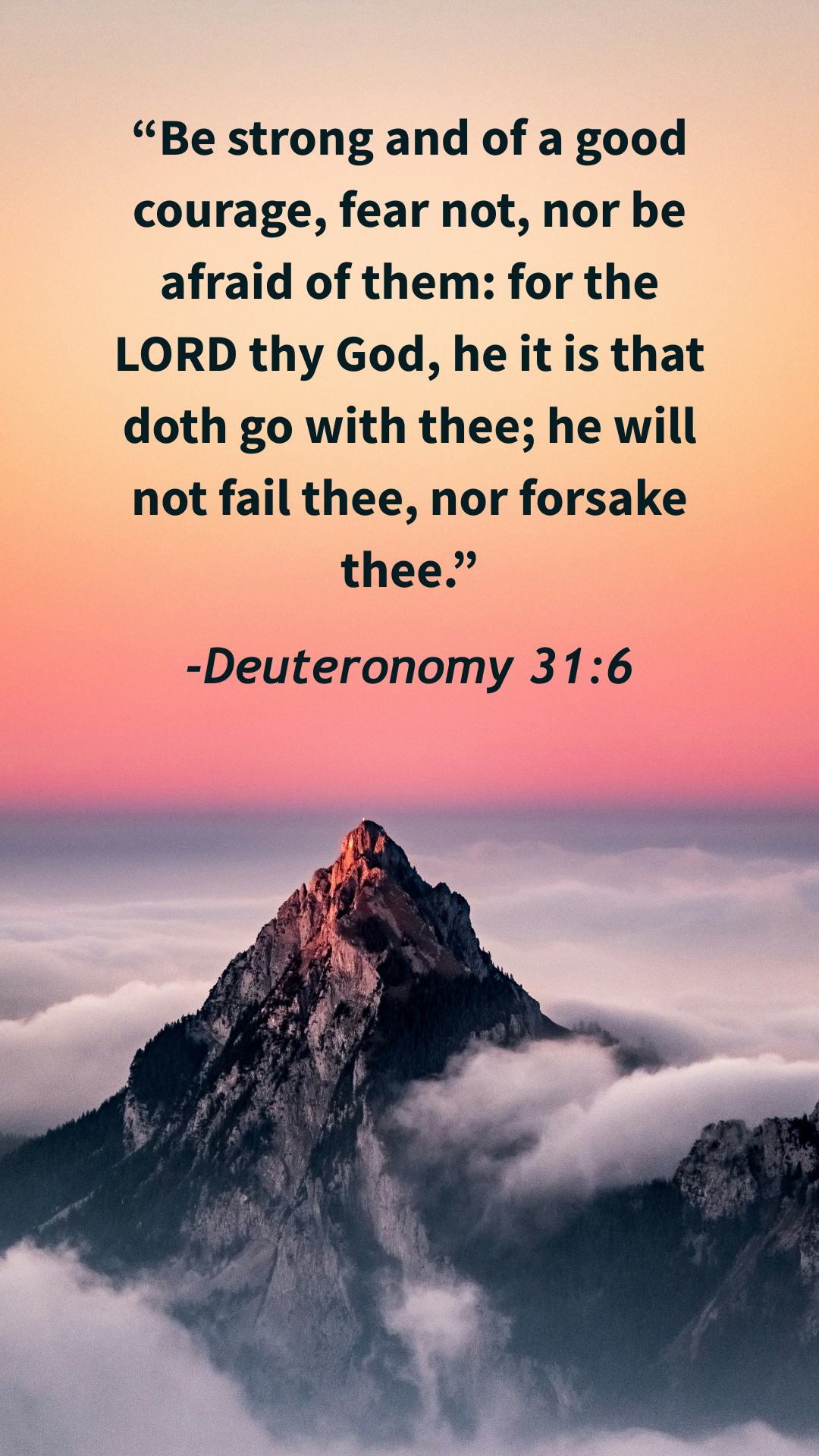
Deuteronomy 31:6 — “Be strong and of a good courage, fear not, nor be afraid of them: for the LORD thy God, he it is that doth go with thee; he will not fail thee, nor forsake thee.”
Deuteronomy 31:6 echoes that same “be strong and of a good courage” charge, but tacks on this reassurance at the end that really seals the deal — “he will not fail thee, nor forsake thee” — like God’s ruling out the two things exhaustion makes you fear most: that he’ll drop the ball or just walk away. It doesn’t just command courage out of nowhere, it grounds that courage in a promise of presence that doesn’t have an expiration date, which is exactly the kind of reassurance you need when you’re running low on your own.
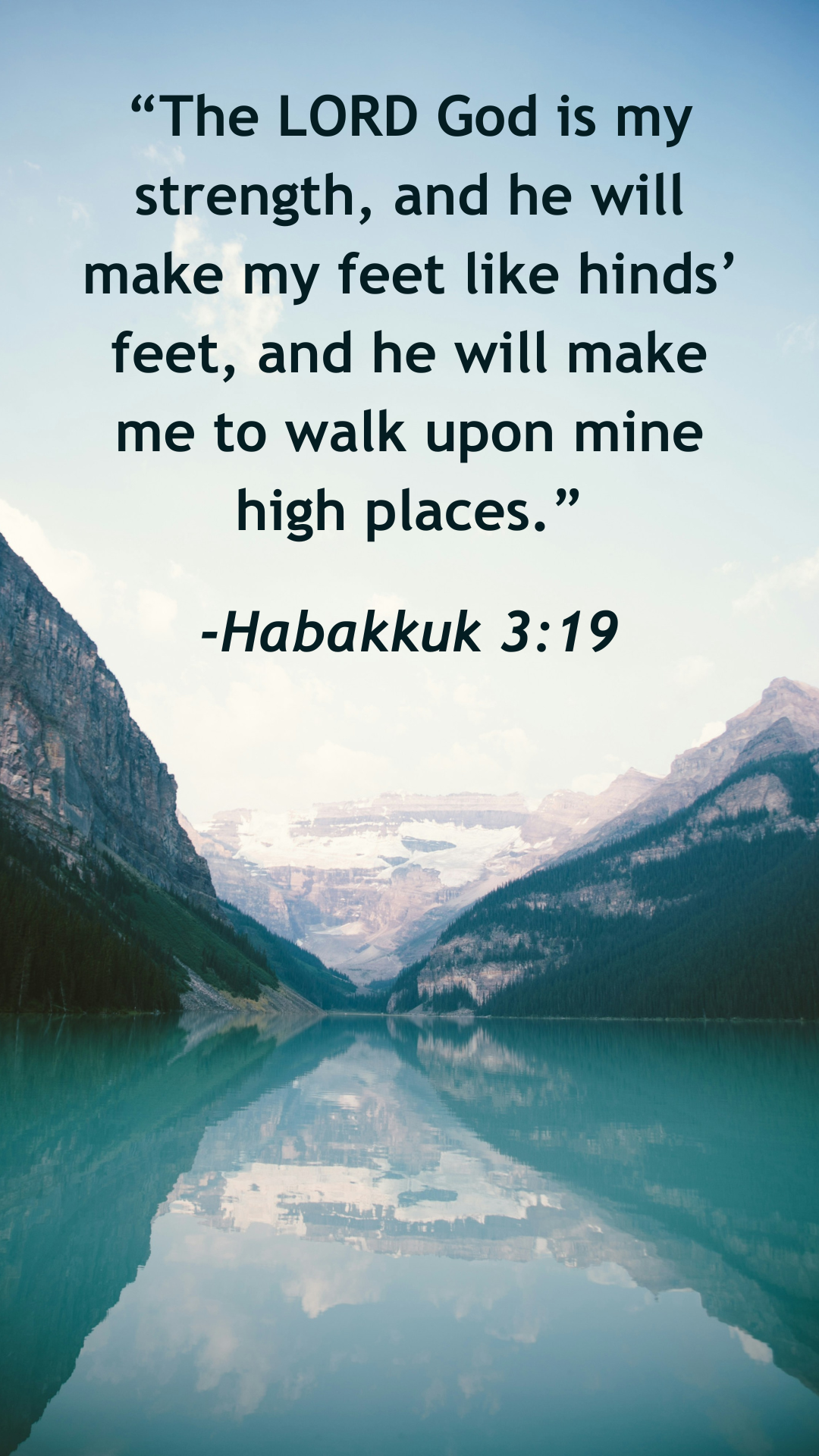
Habakkuk 3:19 — “The LORD God is my strength, and he will make my feet like hinds’ feet, and he will make me to walk upon mine high places.”
Habakkuk 3:19 uses this vivid image — feet like a deer’s, “hinds’ feet” — built for sure-footed climbing even on rocky, uneven ground, and pairs it with the promise of walking on “high places” instead of stumbling through the low ones. It’s not just about surviving the climb, it’s about God actually equipping you for it, turning shaky, exhausted steps into something steady and sure, precisely because the strength behind those steps is his and not something you had to scrape together yourself.

Verses of Hope for the Future
Letting go often means releasing our grip on how we thought things would turn out — and trusting there’s a good plan even when we can’t see it yet.
Jeremiah 29:11 — “For I know the thoughts that I think toward you, saith the LORD, thoughts of peace, and not of evil, to give you an expected end.”
Jeremiah 29:11 is God saying “I already know what I’m thinking about you, and it’s good” — his thoughts toward you are described as “thoughts of peace, and not of evil,” aimed at giving you a hopeful, “expected end” rather than leaving your future up in the air. It puts the security of your future in God’s intentions rather than your own ability to predict or control what’s coming next.
Romans 8:28 — “And we know that all things work together for good to them that love God, to them who are the called according to his purpose.”
Romans 8:28 doesn’t promise that every single thing that happens is good on its own — it promises that “all things work together for good,” which is a much bigger claim, suggesting God’s weaving even the hard, confusing stuff into something purposeful over time. It lets you hold onto a future that makes sense even when the present doesn’t, trusting that the “working together” part is happening whether or not you can see it yet.
Romans 15:13 — “Now the God of hope fill you with all joy and peace in believing, that ye may abound in hope, through the power of the Holy Ghost.”
Romans 15:13 paints a pretty full picture of what hope actually looks like lived out — joy, peace, and hope itself, “filled” in you as you’re “believing,” and all of it powered “through the power of the Holy Ghost” rather than something you talk yourself into. It shows hope isn’t just a mindset you force — it’s something God actively fills you with, meaning your hope for the future is tied to his power, not your own capacity to stay positive.
Psalm 138:8 — “The LORD will perfect that which concerneth me: thy mercy, O LORD, endureth for ever: forsake not the works of thine own hands.”
Psalm 138:8 has this quiet confidence to it — “the LORD will perfect that which concerneth me” — like the psalmist trusts God to finish what he started rather than leaving things half-done, and then backs it up by calling on God’s “mercy” that “endureth for ever” and reminding him that you’re “the works of thine own hands”. It roots your future not in your own follow-through, but in God’s commitment to complete what he began and never abandon his own work.
Lamentations 3:22-23 — “It is of the LORD’s mercies that we are not consumed, because his compassions fail not. They are new every morning: great is thy faithfulness.”
Lamentations 3:22-23 is wild when you remember it’s coming out of a book about grief and devastation, yet it still lands on this hopeful note — his mercies are why “we are not consumed,” and even better, those mercies aren’t a one-and-done thing, they’re “new every morning”. It doesn’t ignore the hard stuff around it, it just insists that no matter how bad yesterday was, God’s faithfulness shows up fresh again today, giving you a real reason to expect good things tomorrow too.
Hebrews 13:5 — “Let your conversation be without covetousness; and be content with such things as ye have: for he hath said, I will never leave thee, nor forsake thee.”
Hebrews 13:5 pairs an interesting combo — a call to ditch covetousness and be content with what you’ve already got — with this rock-solid promise tacked on at the end, “I will never leave thee, nor forsake thee”. It shows contentment isn’t about pretending you don’t want more, it’s about resting in the security of God’s permanent presence, which means your hope for the future isn’t tied to accumulating things, but to a promise that isn’t going anywhere.
James 1:2-4 — “My brethren, count it all joy when ye fall into divers temptations; knowing this, that the trying of your faith worketh patience. But let patience have her perfect work, that ye may be perfect and entire, wanting nothing.”
James 1:2-4 asks something pretty counterintuitive — to “count it all joy” in the middle of trials, not because the trials themselves feel good, but because there’s a process happening underneath them. Where “the trying of your faith worketh patience,” and that patience is given room to do its “perfect work” until you come out “entire, wanting nothing”. It reframes hard seasons as productive rather than pointless, giving you a reason to expect that who you’re becoming through the trial is worth more than a quick escape from it.

Verses for When You Need Courage to Actually Let Go
Trusting God is a decision, made and remade daily, not a single feeling.
Psalm 9:10 — “And they that know thy name will put their trust in thee: for thou, LORD, hast not forsaken them that seek thee.”
Psalm 9:10 ties trust directly to knowing God’s name — the idea being that the more you actually know who he is, the more natural it becomes to put your trust in him — and backs it with the reassurance that he “hast not forsaken them that seek thee”. It shows trust isn’t a blind leap, it’s built on track record — once you’ve seen he doesn’t abandon the people who seek him, releasing your grip on control starts to feel less like a risk and more like just catching up to what’s already true.
Psalm 56:3 — “What time I am afraid, I will trust in thee.”
Psalm 56:3 doesn’t pretend fear won’t show up — it actually starts with “what time I am afraid,” admitting the fear is real — but then makes this deliberate choice right after it: “I will trust in thee”. It shows trust isn’t the absence of fear, it’s the decision you make in spite of it, choosing to loosen your grip on control in the exact moment you’d rather clench it tighter.
Psalm 143:8 — “Cause me to hear thy lovingkindness in the morning; for in thee do I trust: cause me to know the way wherein I should walk; for I lift up my soul unto thee.”
Psalm 143:8 opens with this honest ask — “cause me to hear thy lovingkindness in the morning” — like the psalmist knows he needs God to actively remind him of his love before he can even face the day, and that same dependence carries into asking God to “cause me to know the way wherein I should walk”. It models what courage to release control actually looks like in practice — not pretending you can figure out the way yourself, but lifting your soul up and asking to be shown, one morning at a time.
Psalm 121:1-2 — “I will lift up mine eyes unto the hills, from whence cometh my help. My help cometh from the LORD, which made heaven and earth.”
Psalm 121:1-2 starts with this instinctive move — lifting your eyes up to the hills, searching for where help might come from — but then redirects that search to its actual source: “my help cometh from the LORD, which made heaven and earth”. It points out that looking around at your own resources or circumstances for help will only get you so far, and real courage to release control comes from recognizing your help was never meant to come from you in the first place, but from the one who made everything.
Proverbs 19:21 — “There are many devices in a man’s heart; nevertheless the counsel of the LORD, that shall stand.”
Proverbs 19:21 is pretty blunt about it — you can have a whole heart full of “devices,” plans, schemes, and backup plans for your plans, but at the end of the day “the counsel of the LORD, that shall stand.” <eaning his purpose is what actually holds up. It takes the pressure off having to perfectly engineer your own future, freeing you to loosen your grip on your plans once you realize his counsel was always going to be the one that wins out anyway.
How to Actually Use These Verses in Difficult Seasons
Reading a verse once rarely changes how we feel in the moment. Here are a few ways people put these verses to work:
Write one down and carry it with you.
A verse on a sticky note on your bathroom mirror or the lock screen of your phone becomes something you see before the anxious thoughts have a chance to take over.
Pray it back to God.
Turn Psalm 55:22 into a prayer: “Lord, I am casting this burden on you right now — my finances, my health, my relationship. I trust you to sustain me.” Speaking a verse as a prayer makes it personal instead of abstract.
Journal alongside a verse.
Write out the verse, then write what specifically you’re being asked to let go of, and what it would look like to trust God with it instead. Faith journaling let’s you use your creative talents to create faith-based art and prose.
Memorize a small set for hard moments.
Choose three or four — one for anxiety, one for grief, one for fear, one for hope — and commit them to memory so they’re available even when you don’t have a Bible in hand.
Return to the same verse daily during a season of struggle.
Repetition isn’t a lack of faith; it’s how truth moves from your head to your heart.
Share them with someone else who’s struggling.
Sending a verse to a friend going through a hard time is one of the simplest ways to remind them — and yourself — that they aren’t carrying it alone.
A Final Word
Letting go and letting God is rarely a one-time decision. It’s a posture you return to again and again — every time fear creeps back in, every time you’re tempted to grab the wheel again. These verses aren’t magic words that erase hardship. They’re reminders, repeated across scripture in different voices and different centuries, that you were never meant to carry everything by yourself. Whatever you’re walking through right now, there is a verse above written for exactly that moment. Let it be enough, today, to lay it down.






One Comment
Comments are closed.