
Uplifting Bible Verses: 30 Passages That Bring Hope, Peace and Strength for Today
Life has a way of piling weight onto our shoulders faster than we can set it down. Bills stack up, relationships get complicated, health scares knock the wind out of us, and some mornings the news alone is enough to make you want to pull the covers back over your head. In moments like these, people have turned to Scripture for thousands of years, not because it magically erases hardship, but because it offers something steadier than a mood or a headline. It offers perspective, comfort, and a reminder that we are not walking through any of this alone.
This guide gathers 30 uplifting Bible verses, most of them less commonly quoted than the usual handful you see recycled everywhere online. For each one, you’ll find the verse itself, a plain-language explanation of what it meant in its original context, and a look at how it applies to the pressures of modern life, whether that’s burnout, anxiety, grief, financial stress, or just the general exhaustion of trying to keep it all together. Toward the end, we’ll talk about how faith functions differently depending on the season of life you’re in, and we’ll close with practical, doable ways to actually put these verses to work instead of just reading them once and moving on.
Why Uplifting Bible Verses Still Matter in a Distracted, Anxious World
Anxiety disorders affect a huge share of adults, and even people without a clinical diagnosis report feeling more stressed than they did a decade ago. Phones buzz constantly, work bleeds into evenings, and comparison culture on social media chips away at contentment. Against that backdrop, an ancient text might seem like an odd place to look for relief. But the Bible was written by and for people who knew exile, famine, betrayal, illness, and loss firsthand. It was not composed in a comfortable studio; it came out of real suffering and real hope, which is part of why its words still land with weight today.
Reading uplifting Bible verses is not about pretending everything is fine. It is about anchoring yourself to something bigger than the current crisis. Whether you grew up in church, are exploring faith for the first time, or simply want words that steady you on a hard day, these passages offer a place to stand.
30 Uplifting Bible Verses and What They Mean for Life Today
1. Psalm 34:18 – “The Lord is near to the brokenhearted and saves the crushed in spirit.”
David wrote this psalm while he was literally on the run, pretending to be insane to escape a king who wanted him dead. This was not written from a place of comfort. The verse tells us that closeness to God is not reserved for people who have it together. If anything, it is promised most directly to people who feel shattered. For anyone dealing with grief, depression, or the numbness that follows a hard diagnosis, this verse is a reminder that brokenness does not push God away. It draws Him closer.
2. Isaiah 40:31 – “But they who wait for the Lord shall renew their strength; they shall mount up with wings like eagles.”
Isaiah was speaking to a weary, exiled nation that felt forgotten. The image of renewed strength and rising like an eagle is about endurance, not a quick fix. In modern life, this speaks directly to burnout. If you are running on empty at work, in parenting, or in caregiving for an aging parent, this verse suggests that waiting, actual patient waiting rather than white-knuckling through exhaustion, is part of how strength gets restored.
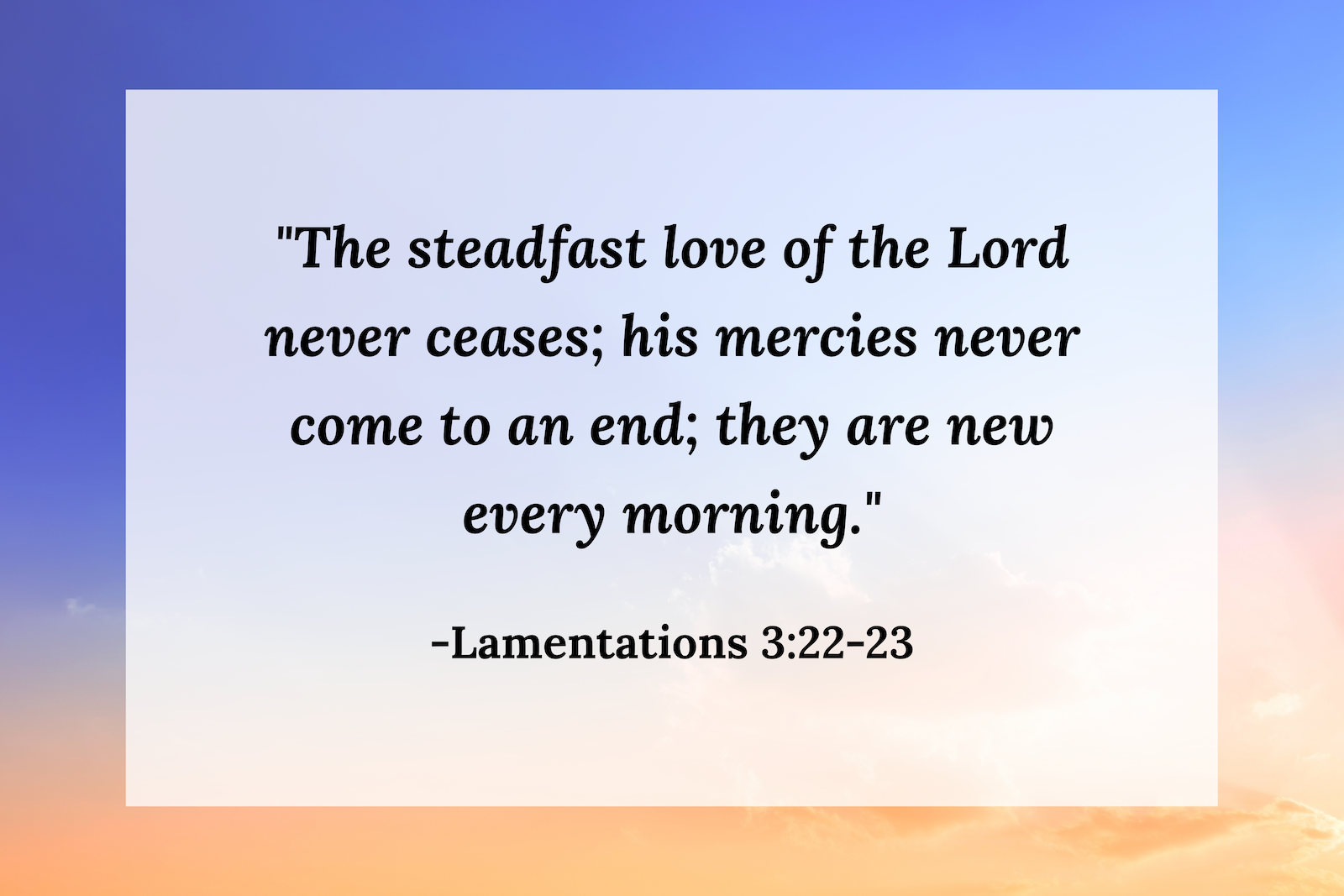
3. Lamentations 3:22-23 – “The steadfast love of the Lord never ceases; his mercies never come to an end; they are new every morning.”
Lamentations is, true to its name, a book of grief over the destruction of Jerusalem. Yet in the middle of all that sorrow, the author pauses to declare that mercy resets daily. This is a powerful verse for anyone recovering from addiction, a failed relationship, or a mistake they cannot stop replaying. Yesterday’s failure does not define this morning. There is a fresh start built into each sunrise.
4. Nahum 1:7 – “The Lord is good, a stronghold in the day of trouble; he knows those who take refuge in him.”
Nahum is one of the more overlooked minor prophets, but this verse carries real comfort. A stronghold is a place of safety during an attack, not after it. For people facing ongoing stress, whether that’s a chronic illness, a difficult legal situation, or an unstable job market, this verse offers refuge in the middle of the storm, not just after it passes.
5. Zephaniah 3:17 – “The Lord your God is in your midst, a mighty one who will save; he will rejoice over you with gladness; he will quiet you by his love; he will exult over you with loud singing.”
This verse reads almost like a parent comforting a frightened child, and that is intentional. It describes God not as distant or disappointed, but as someone who takes joy in you and calms you the way a parent quiets a crying baby. For anyone who has internalized shame or feels like they are constantly falling short, this verse reframes the relationship entirely. You are not a disappointment to manage. You are someone to delight in.
6. Habakkuk 3:17-18 – “Though the fig tree should not blossom… yet I will rejoice in the Lord; I will take joy in the God of my salvation.”
Habakkuk lists total agricultural failure, essentially total financial ruin in an agrarian economy, and still chooses joy. This verse is remarkably relevant to job loss, market downturns, or watching a business you built struggle. Joy here is not naive optimism. It is a decision made in spite of circumstances, not because of them.
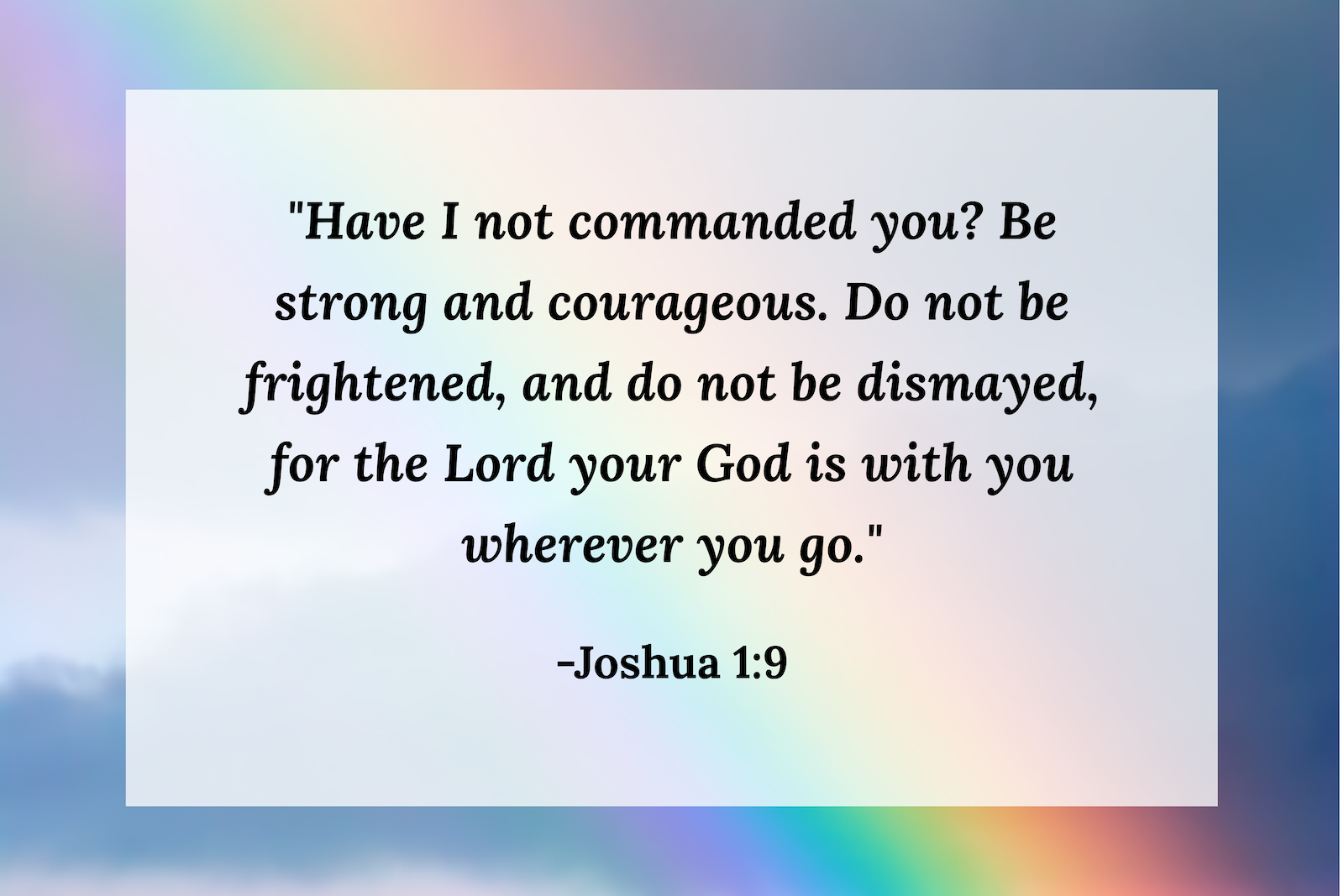
7. Joshua 1:9 – “Have I not commanded you? Be strong and courageous. Do not be frightened, and do not be dismayed, for the Lord your God is with you wherever you go.”
Joshua was about to lead a nation into unfamiliar, dangerous territory after the death of Moses, the only leader most of them had ever known. Transitions like this, starting a new job, moving to a new city, becoming a parent, are genuinely frightening. This verse does not promise the fear will disappear. It promises companionship through it.
8. Deuteronomy 31:8 – “It is the Lord who goes before you. He will be with you; he will not leave you or forsake you. Do not fear or be dismayed.”
Similar in spirit to Joshua 1:9 but worth including separately because of the specific promise that God goes ahead of you, not just alongside you. For anyone stepping into an uncertain future, whether that’s a health diagnosis with an unclear outcome or a major life decision, this verse suggests the path has already been walked ahead of you.
9. Psalm 30:5 – “Weeping may tarry for the night, but joy comes with the morning.”
This verse acknowledges that pain is real and sometimes lasts a long time (a night, in ancient terms, could be long and dark) but insists it is not permanent. This is especially meaningful for anyone in the thick of grief who feels guilty for imagining a future where they laugh again. Morning is allowed to come.
10. Psalm 55:22 – “Cast your burden on the Lord, and he will sustain you; he will never permit the righteous to be moved.”
David wrote this after being betrayed by a close friend. The verb “cast” implies actively throwing something off, not just quietly hoping it disappears. This is a useful mental image for anyone who tends to carry stress internally instead of releasing it, whether through prayer, journaling, or talking to someone they trust.
11. Psalm 94:19 – “When the cares of my heart are many, your consolations cheer my soul.”
This verse is honest about anxious thought spirals, “cares… many,” and pairs that honesty with the promise of comfort. It doesn’t pretend the worries vanish. It says comfort meets you in the middle of them.
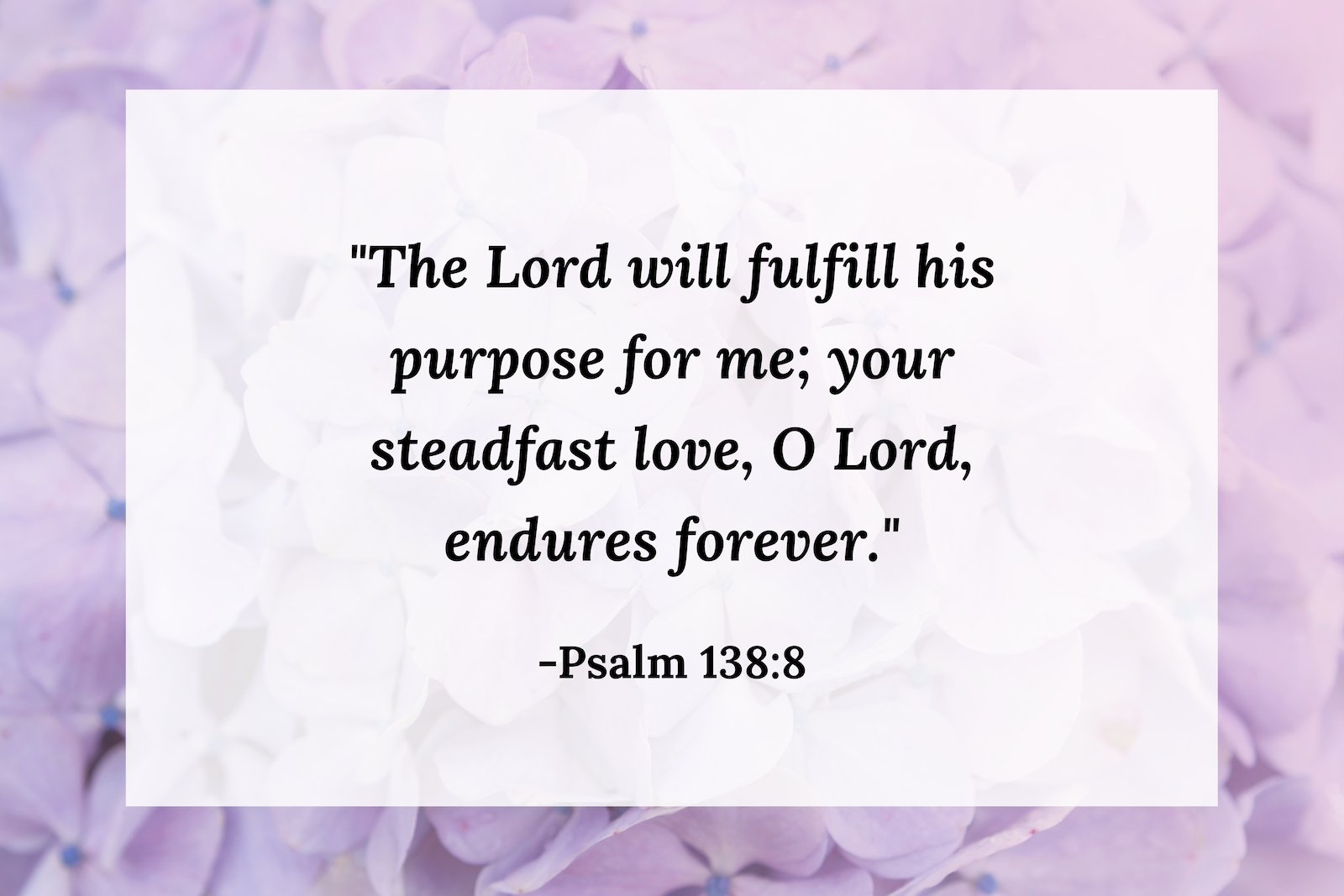
12. Psalm 138:8 – “The Lord will fulfill his purpose for me; your steadfast love, O Lord, endures forever.”
This is a quiet confidence verse, useful for people in a season of uncertainty about their direction in life, whether that’s a career pivot, a delayed dream, or simply not knowing what comes next.
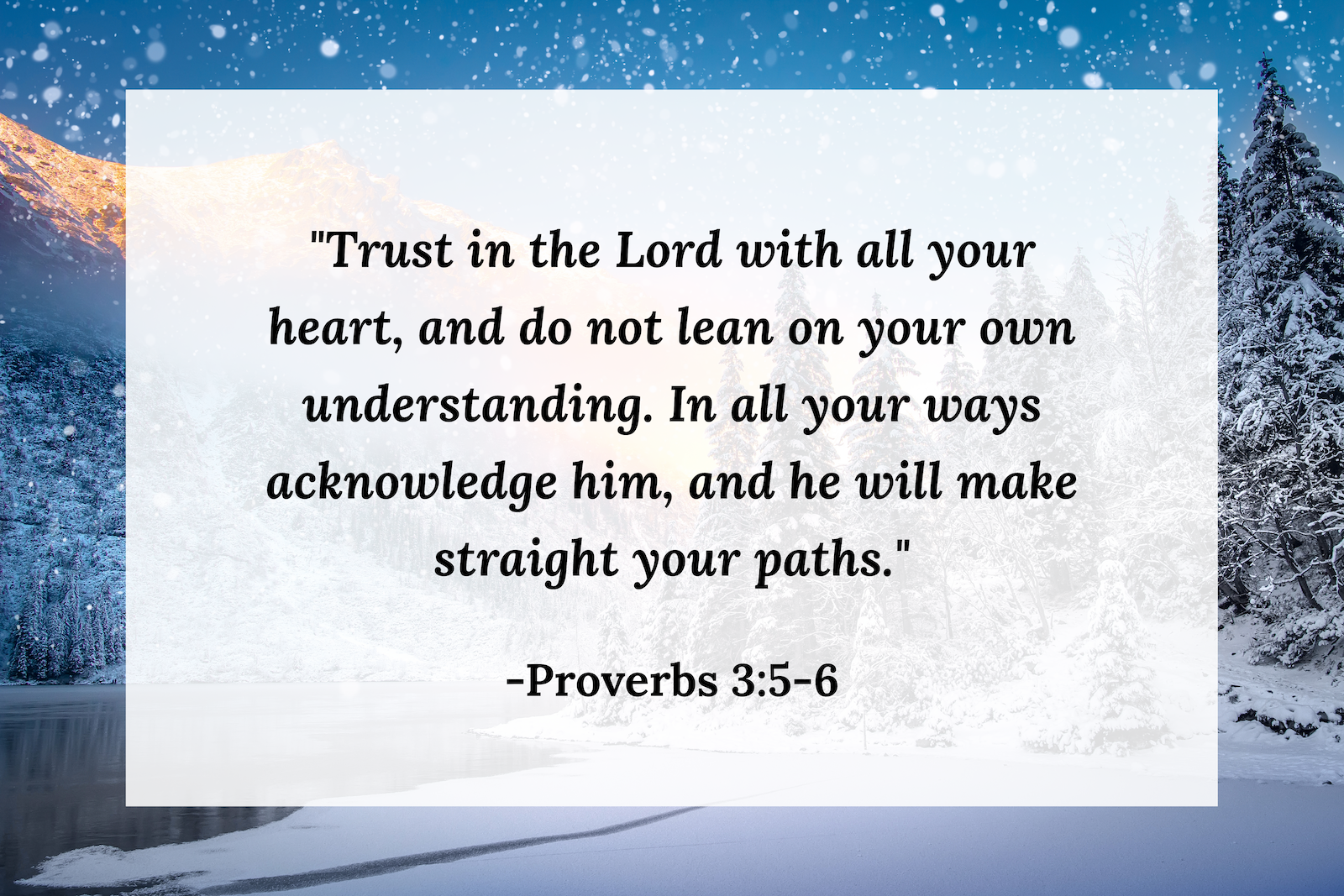
13. Proverbs 3:5-6 – “Trust in the Lord with all your heart, and do not lean on your own understanding. In all your ways acknowledge him, and he will make straight your paths.”
One of the most practical verses in Proverbs, this passage speaks to decision fatigue, a very real modern problem. When every choice, career, relationships, finances, feels like it rests entirely on your own judgment, this verse offers a different posture: partnership instead of total self-reliance.
14. Proverbs 17:22 – “A joyful heart is good medicine, but a crushed spirit dries up the bones.”
This verse is almost startlingly modern in how it connects emotional state to physical health, something research on stress and the body has only caught up with in recent decades. It is a gentle nudge to take joy seriously as part of overall wellbeing, not a luxury.
15. Isaiah 41:10 – “Fear not, for I am with you; be not dismayed, for I am your God; I will strengthen you, I will help you, I will uphold you with my righteous right hand.”
This verse stacks four separate promises in a row: presence, strength, help, and support. For someone facing a specific fear, a medical test, a difficult conversation, a financial cliff, the repetition itself is comforting. It reads like someone repeating reassurance until it actually sinks in.
16. Isaiah 43:2 – “When you pass through the waters, I will be with you; and through the rivers, they shall not overwhelm you.”
Notice this verse does not say you will avoid the water. It says you will pass through it and not be overwhelmed. This distinction matters for anyone going through something they cannot avoid, a layoff, a divorce, a diagnosis. The promise is not escape. It is survival with presence.
17. Matthew 11:28-30 – “Come to me, all who labor and are heavy laden, and I will give you rest… For my yoke is easy, and my burden is light.”
Jesus spoke this to a crowd worn down by rigid religious expectations. Today it speaks just as clearly to anyone worn down by hustle culture, the pressure to always be optimizing, achieving, and producing. Rest here is offered, not earned.
18. John 14:27 – “Peace I leave with you; my peace I give to you… Let not your hearts be troubled, neither let them be afraid.”
Jesus said this to His disciples right before His arrest and crucifixion, one of the most unstable moments imaginable. The peace offered isn’t dependent on circumstances being calm. That distinction is enormously relevant to anyone trying to find peace while their external world is anything but peaceful.
19. Romans 12:12 – “Rejoice in hope, be patient in tribulation, be constant in prayer.”
This verse gives a three-part rhythm: hope, patience, prayer, for navigating hard seasons without falling into either denial or despair. It’s a practical framework as much as an inspirational line.
20. Romans 15:13 – “May the God of hope fill you with all joy and peace in believing, so that by the power of the Holy Spirit you may abound in hope.”
This verse describes hope as something that can overflow, “abound,” rather than something you have to scrape together on your own. For anyone feeling emotionally depleted, that image of being filled rather than having to generate hope from nothing is a relief.
21. 2 Corinthians 4:16-18 – “So we do not lose heart… For this light momentary affliction is preparing for us an eternal weight of glory beyond all comparison.”
Paul wrote this while dealing with persecution, physical hardship, and constant danger. The phrase “light momentary affliction” is not meant to minimize suffering. It’s a perspective shift, viewing present pain against the backdrop of something much larger than the current moment.
22. 2 Corinthians 12:9 – “My grace is sufficient for you, for my power is made perfect in weakness.”
Paul asked God three times to remove a physical struggle, referred to only as a “thorn in the flesh,” and was told no. This verse matters enormously for people living with chronic illness, disability, or ongoing limitations that will not simply go away. It reframes weakness not as failure but as the very place where strength shows up most clearly.
23. Galatians 6:9 – “And let us not grow weary of doing good, for in due season we will reap, if we do not give up.”
This verse acknowledges that doing the right thing, whether that’s parenting well, showing up for a struggling friend, or staying honest in a difficult job, often does not pay off immediately. It’s an encouragement for the long, unglamorous middle of any worthwhile effort.
24. Ephesians 3:20 – “Now to him who is able to do far more abundantly than all that we ask or think, according to the power at work within us.”
This verse pushes back against small thinking. For anyone stuck imagining only the most limited version of how their situation could improve, this verse suggests the actual possibilities are wider than what we can picture.
25. Philippians 4:6-7 – “Do not be anxious about anything, but in everything by prayer and supplication with thanksgiving let your requests be made known to God, and the peace of God, which surpasses all understanding, will guard your hearts and minds.”
Paul wrote this from prison. He is not offering theoretical advice about anxiety; he lived it while writing it. The pairing of prayer with thanksgiving is worth noting. Gratitude alongside requests changes the emotional tone of worry itself.
26. Colossians 3:15 – “And let the peace of Christ rule in your hearts, to which indeed you were called in one body. And be thankful.”
The word “rule” here suggests peace acting like a referee, something that gets the final say when emotions are in conflict. That’s a useful, practical image for anyone trying to manage reactive anger, anxiety, or overwhelm in the moment.
27. 1 Thessalonians 5:16-18 – “Rejoice always, pray without ceasing, give thanks in all circumstances; for this is the will of God in Christ Jesus for you.”
This is one of the shortest instructions in the New Testament and one of the hardest to actually live out. It doesn’t say rejoice because everything is good. It says rejoice always, which implies a posture that exists independently of circumstances, something closer to a practiced discipline than a spontaneous feeling.
28. 2 Timothy 1:7 – “For God gave us a spirit not of fear but of power and love and self-control.”
Paul wrote this to a younger leader, Timothy, who appears to have struggled with timidity and anxiety about his responsibilities. This verse is a useful one to sit with before a hard conversation, a big decision, or any moment where fear is trying to talk you out of something you know you need to do.
29. Hebrews 12:1-2 – “Let us run with endurance the race that is set before us, looking to Jesus, the founder and perfecter of our faith.”
The imagery of a long race rather than a sprint is important. Modern life often rewards quick wins and instant results, but this verse frames endurance itself as the goal, useful for anyone in a long recovery process, a lengthy job search, or a slow-healing relationship.
30. 1 Peter 5:7 – “Casting all your anxieties on him, because he cares for you.”
This verse pairs beautifully with Psalm 55:22 above but deserves its own spot because of that final phrase, “because he cares for you.” It roots the invitation to release anxiety not in a command to just stop worrying, but in the reason behind the invitation: genuine care.
How Faith Sustains Believers Through Every Season of Life
Faith does not operate the same way in every stage of life, and expecting it to can leave people feeling like something is wrong with them when it doesn’t. It helps to think of faith the way you’d think of clothing for actual seasons. What works in the middle of a brutal winter is not what you’d reach for in the easy warmth of summer.
In seasons of grief and loss, faith rarely shows up as answers. It shows up as presence, the sense that you are not alone in the dark even when nothing makes sense. Verses like Psalm 34:18 and Psalm 30:5 speak directly into this season, not by explaining suffering but by promising nearness within it.
In seasons of uncertainty and transition, faith functions more like a compass than a map. You may not know exactly where the road leads, but verses like Joshua 1:9 and Deuteronomy 31:8 offer confidence that you are not walking it solo, even when every step feels unfamiliar.
In seasons of exhaustion and burnout, faith often looks like permission to rest. Matthew 11:28-30 is direct about this: rest is offered, not something you have to earn by finally getting everything done. This is countercultural in a world that treats busyness as a badge of honor.
In seasons of financial or material stress, faith gets tested in a very concrete way. Habakkuk’s declaration of joy despite total agricultural loss (essentially total financial ruin for his time) is a strong model here. It doesn’t deny the hardship. It insists joy and stability can exist somewhere other than in your bank balance.
In seasons of anxiety and mental health struggles, faith often works best paired with real, tangible action, therapy, medication when needed, community support, alongside prayer and Scripture rather than instead of them. Philippians 4:6-7 explicitly pairs prayer with practical thanksgiving, modeling faith as one piece of a larger toolkit rather than a replacement for all other forms of care.
In seasons of joy and abundance, faith shows up as gratitude rather than entitlement. It’s easy to thank God during hardship because you’re desperate for help. It’s a quieter, more deliberate discipline to keep that same posture when life is going well, and 1 Thessalonians 5:18’s instruction to give thanks “in all circumstances” includes the good ones too.
The common thread across every season is this: faith is not a single feeling you either have or don’t have. It’s a relationship that shifts shape depending on what you’re carrying, and Scripture offers different verses for different loads because different loads require different kinds of comfort.
Practical Ways to Use Uplifting Bible Verses in Daily Life
Reading a verse once and moving on rarely changes much. Here are concrete ways to actually let these words shape your day-to-day life.
Start with a single verse each morning instead of scrolling.
Before checking your phone, read one verse from this list and sit with it for sixty seconds. Starting the day with intention rather than reactive scrolling changes the emotional tone of everything that follows.
Write verses on index cards and place them where you’ll actually see them.
The bathroom mirror, the dashboard of your car, the inside of a kitchen cabinet. Repetition through casual, everyday exposure works far better than trying to memorize a verse in one sitting.
Pair a verse with a specific worry.
If you’re anxious about finances, return to Habakkuk 3:17-18. If you’re anxious about a decision, return to Proverbs 3:5-6. Building this kind of mental association means the right verse comes to mind naturally when the matching stress hits.
Journal your reaction to a verse instead of just reading it.
Spend five minutes writing what a verse means to your specific situation right now. This turns passive reading into active reflection and tends to make the verse stick much longer.
Say a verse out loud during moments of panic.
There’s something different about speaking words aloud versus just thinking them. If anxiety spikes, saying Isaiah 41:10 out loud, even quietly, can interrupt a spiral in a way silent reading sometimes can’t.
Share a verse with someone else going through something hard.
Texting a friend a verse that matches their specific struggle, grief, job loss, illness, does double duty. It encourages them and reinforces the verse in your own memory.
Use a Bible app with a daily reminder.
Setting a phone notification for a specific time each day to read a short passage removes the reliance on willpower and turns the habit into something automatic.
Revisit the same verse across a hard season instead of always looking for something new.
Sometimes the most helpful thing is returning to one verse again and again over weeks rather than treating Scripture like content to consume once and discard.
Combine a verse with a breathing exercise.
Read a short verse, then take four slow breaths while repeating a key phrase from it in your mind. This blends a grounding physical practice with the emotional weight of the words.
Where to Go Deeper
For anyone who wants to study these verses further, sites like BibleGateway let you compare translations side by side, which can bring out nuances a single version might miss. Blue Letter Bible is a strong resource if you want to look at the original Hebrew or Greek behind a passage. And Desiring God offers thoughtful, theologically grounded articles if you want commentary that goes beyond a quick verse-of-the-day summary.
Final Thoughts
None of these 30 verses erase hardship on contact. That was never the promise. What they offer instead is companionship through it, a reminder that people who lived through exile, persecution, grief, and uncertainty found something steady enough to hold onto, and wrote it down so it could hold the rest of us too. Whatever season you’re in right now, there’s likely a verse above that speaks directly into it. The real work isn’t finding the right words. It’s letting them actually sink in.





3 Comments