
Biblical Encouragement: How God’s Word Strengthens Us and Others

Everyone runs low on hope at some point. A hard diagnosis, a job loss, a friendship that fell apart, a season of doubt that won’t lift. When life presses in, most of us aren’t looking for a pep talk. We’re looking for something sturdier than “you’ve got this.” We’re looking for truth we can actually stand on.
That’s what biblical encouragement offers. It’s not a greeting card sentiment or a burst of positive thinking. It’s a specific, God-centered way of speaking life into someone’s soul, rooted in who God is and what he has already done. The Bible doesn’t just describe encouragement. It commands it, models it, and gives us a working vocabulary for how to do it well.
This post walks through what Scripture actually says about encouragement, a set of verses you can hold onto (with plain-language explanations of how they apply to your Tuesday afternoon, not just Bible class), and a collection of biblical methods for encouraging the people around you. Whether you’re a pastor, a small group leader, a parent, or just someone who wants to be a better friend, this is meant to be something you can use, not just read.

What Does the Bible Actually Mean by “Encouragement”?
The English word “encourage” gets used loosely. We encourage kids to eat their vegetables and encourage coworkers to hit a deadline. But in the New Testament, the word behind most references to encouragement is the Greek term parakaleo, which literally means “to call alongside.” It’s the same root word used for the Holy Spirit as our Comforter or Helper in John 14. Encouragement, biblically speaking, is the act of coming alongside someone in their actual situation, not standing at a distance and cheering.
That distinction matters. Biblical encouragement isn’t primarily about making someone feel better in the moment, though it often does that. It’s about reminding someone of what’s true when they’ve lost sight of it: that God is present, that God is working, that God has not forgotten them, and that their labor and faith are not in vain. You can see this definition unpacked well in 9Marks’ piece on encouraging one another, which points out that biblical encouragement is fundamentally different from complimenting someone’s haircut. It’s aimed at the soul, not just the surface.
This is also why the Bible treats encouragement as a command, not a personality trait reserved for a few naturally upbeat people. Passages like 1 Thessalonians 5:11 and Hebrews 10:24-25 don’t say “encourage one another if it comes easily to you.” They say to do it, and to do it often. If you want a fuller picture of the original language and cross-references for these commands, Blue Letter Bible’s Greek lexicon tool is a solid resource for digging into individual words like parakaleo and paramytheomai, the two most common terms for encouragement in the New Testament.

Why Encouragement Is Not Optional for Believers
There’s a reason the Bible treats a lack of encouragement as spiritually dangerous. Hebrews 3:12-13 warns that without daily encouragement, believers can be “hardened by sin’s deceitfulness.” That’s a strong statement. It suggests that isolation and silence aren’t neutral. Left unchecked, they create room for discouragement to calcify into unbelief.
Think about how this plays out practically. A single mom who hears nothing but silence from her church for months starts to wonder if anyone actually cares whether she’s still following Jesus. A man wrestling with a besetting sin starts to believe the lie that he’s the only one who struggles this much, because nobody around him talks honestly about their own battles. A teenager questioning her faith interprets everyone’s silence as proof that faith doesn’t hold up to real scrutiny. None of these outcomes happen because people meant harm. They happen because encouragement was missing.
This is part of why Scripture ties encouragement so closely to Christian community rather than treating it as an individual devotional practice. You can read your Bible alone every morning and still be starving for encouragement if no one in your life is speaking truth over you. The command to encourage one another assumes there will be an “one another” to encourage, which means it assumes real relationships, not just correct theology.

Bible Verses on Encouragement and What They Mean Today
Here are verses that show up again and again in the lives of people going through something hard, along with a plain explanation of what each one is actually asking of you today.
Isaiah 41:10
“So do not fear, for I am with you; do not be dismayed, for I am your God. I will strengthen you and help you; I will uphold you with my righteous right hand.”
This verse was originally spoken to Israel in exile, a nation facing genuine uncertainty about its future. The modern application isn’t “don’t worry, be happy.” It’s that fear and dismay are common, even expected, responses to hard circumstances, but they don’t get the final word. If you’re facing a health scare, a financial cliff, or a decision you can’t see the outcome of, this verse gives you permission to be honest about your fear while still anchoring yourself in God’s active presence, not his distant sympathy.
Joshua 1:9
“Have I not commanded you? Be strong and courageous. Do not be afraid; do not be discouraged, for the Lord your God will be with you wherever you go.”
This was God’s charge to Joshua right before he had to lead a nation into genuinely dangerous territory. Courage here isn’t the absence of fear. It’s obedience in spite of fear, because God’s presence is a fact, not a feeling you have to manufacture. Today, this looks like taking the hard conversation, starting the new job, or walking into the doctor’s office, not because you feel brave, but because you’ve been commanded to move forward with the confidence that you’re not doing it alone.
Romans 15:13
“May the God of hope fill you with all joy and peace as you trust in him, so that you may overflow with hope by the power of the Holy Spirit.”
Notice that hope here isn’t self-generated. It’s something God fills you with, and it flows through trust, not through circumstances lining up. If your current situation gives you no rational reason for hope, this verse says that’s fine, because the source of hope was never supposed to be your circumstances in the first place.
Philippians 4:6-7
“Do not be anxious about anything, but in every situation, by prayer and petition, with thanksgiving, present your requests to God. And the peace of God, which transcends all understanding, will guard your hearts and your minds in Christ Jesus.”
This is one of the most quoted anxiety verses in Scripture for good reason. The instruction isn’t to stop feeling anxious through sheer willpower. It’s to bring the anxiety to God specifically, with thanksgiving attached, and let the peace that follows be something that guards you rather than something you have to conjure. Practically, this might mean literally writing out what you’re anxious about and turning each item into a prayer instead of letting it loop silently in your head.
Psalm 34:17-18
“The righteous cry out, and the Lord hears them; he delivers them from all their troubles. The Lord is close to the brokenhearted and saves those who are crushed in spirit.”
This verse matters because it doesn’t promise the absence of trouble. It promises nearness in the middle of trouble. If you’re grieving, this is one of the few verses that speaks directly to that state without rushing you toward resolution. God’s closeness to the brokenhearted means grief itself isn’t a spiritual failure. It’s the exact place where he says he draws near.
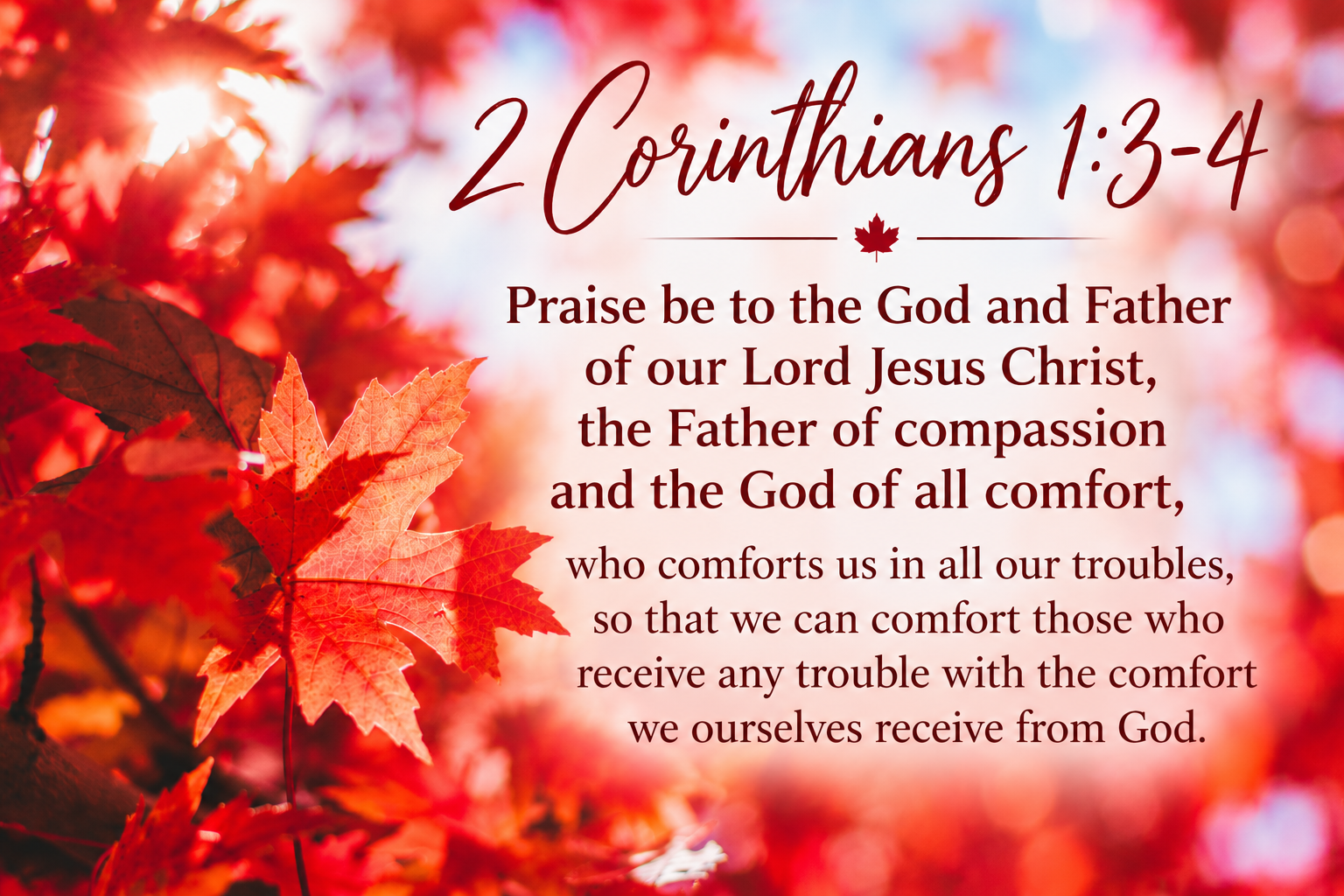
2 Corinthians 1:3-4
“Praise be to the God and Father of our Lord Jesus Christ, the Father of compassion and the God of all comfort, who comforts us in all our troubles, so that we can comfort those who receive any trouble with the comfort we ourselves receive from God.”
This verse gives suffering a purpose beyond itself. Whatever comfort you’ve received from God in your own hard season isn’t meant to end with you. It’s meant to be passed on to the next person who needs it. That reframes painful experiences, a difficult diagnosis, a broken marriage that healed, a season of depression you walked through, as material you’ll one day use to encourage someone else.
Deuteronomy 31:6
“Be strong and courageous. Do not be afraid or terrified because of them, for the Lord your God goes with you; he will never leave you nor forsake you.”
Written to a generation about to face literal battles, this verse’s modern relevance is in the promise itself: God’s presence is not conditional on your performance or your circumstances improving. He goes with you into the hard thing, not just after it’s resolved.
Zephaniah 3:17
“The Lord your God is with you, the Mighty Warrior who saves. He will take great delight in you; in his love he will no longer rebuke you, but will rejoice over you with singing.”
This is one of the more overlooked verses on this list, and it’s worth sitting with. It doesn’t just say God is with you. It says he delights in you and rejoices over you. If your internal narrative tends toward “God is probably disappointed in me,” this verse directly contradicts that. It’s an invitation to receive God’s posture toward you as genuinely joyful, not merely tolerant.
Lamentations 3:22-23
“Because of the Lord’s great love we are not consumed, for his compassions never fail. They are new every morning; great is your faithfulness.”
This verse comes from the middle of a book about the destruction of Jerusalem, written by someone in real grief. That context matters. The hope expressed here isn’t naive positivity. It’s hope that survived catastrophe. If you woke up today carrying yesterday’s failure or yesterday’s grief, this verse says mercy doesn’t run out overnight. It resets.
Romans 8:28
“And we know that in all things God works for the good of those who love him, who have been called according to his purpose.”
This verse gets misused when people apply it to mean everything happening to you is secretly good. That’s not quite what it says. It says God works in all things, including painful and unwanted things, toward good, which is different from saying the thing itself is good. This distinction is what keeps this verse from becoming a way to minimize real suffering.
For a broader library of verses organized by topic, BibleGateway’s topical index on encouragement is a helpful place to keep exploring beyond this list, especially if you’re preparing a devotional, a card for someone, or a small group discussion.
Biblical Methods for Encouraging One Another
Knowing the right verses is only half the equation. The other half is knowing how to actually deliver encouragement in a way that lands. Scripture gives us specific patterns for this, mostly modeled through Paul’s letters to churches he loved. For The Church’s piece on biblical methods for encouraging one another is a great resource for seeing this laid out from the text itself. Below is a similar framework, drawn from Scripture, with different passages and a bit more on how each one works in ordinary relationships.
1. Name what God is doing through them, specifically
It’s easy to affirm someone in general terms. It’s more powerful to point to something concrete. Paul does this constantly, telling the Corinthians that “in every way you were enriched in him in all speech and all knowledge” (1 Corinthians 1:5). The modern version of this is telling a friend, “The way you handled that conversation with your teenager last week, that patience wasn’t nothing. That was God in you.” Vague affirmation is forgettable. Specific affirmation sticks.
2. Remind them their work is not forgotten
Paul writes to the Corinthians that their labor “is not in vain” (1 Corinthians 15:58), a direct counter to the exhaustion that sets in when someone has been serving quietly for a long time with no visible payoff. If you know someone teaching a thankless Sunday school class, caring for an aging parent, or grinding through a hard season at work with no recognition, this is the encouragement they need. Not “you’ll get a reward someday,” but “what you’re doing right now matters, and it’s seen.”
3. Choose words that build up, not just words that are true
Ephesians 4:29 sets a high bar: “Do not let any unwholesome talk come out of your mouths, but only what is helpful for building others up according to their needs, that it may benefit those who listen.” This isn’t a call to flatter people or avoid honesty. It’s a filter for how you say true things. You can correct someone, disagree with someone, or deliver hard news, and still choose language that leaves them more built up than torn down. Proverbs 16:24 puts it even more simply: “Gracious words are a honeycomb, sweet to the soul and healing to the bones.”
4. Sit with people in their grief before you try to fix it
Romans 12:15 instructs believers to “mourn with those who mourn.” Job’s friends, before they opened their mouths and made things worse, actually got this part right. They sat with him in silence for seven days (Job 2:13). Most people rush to fix or explain suffering because sitting in it feels unbearable. But encouragement sometimes looks like showing up, saying almost nothing, and simply not leaving.
5. Carry a burden you weren’t asked to carry
Galatians 6:2 says, “Carry each other’s burdens, and in this way you will fulfill the law of Christ.” This is encouragement as action rather than words. It’s the meal train for a family in crisis, the ride to chemo, the babysitting so exhausted parents can breathe. Words matter, but Scripture is clear that encouragement without corresponding action can be hollow.
6. Say the thank-you out loud, not just in your head
Paul tells the Thessalonians, “We always thank God for all of you, mentioning you in our prayers” (1 Thessalonians 1:2). Most of us think grateful thoughts about people constantly and never say them. The gap between thinking “she’s been such a good friend to me” and actually telling her closes a distance that matters more than it seems like it should. People are almost never annoyed to hear they’re appreciated. They’re moved by it.
7. Encourage in writing, not just in conversation
Much of the New Testament exists because Paul, Peter, John, and others wrote letters of encouragement to people they couldn’t be with in person. A note, a card, a text message someone can reread later carries a different weight than a passing comment. 2 Corinthians 7:6-7 describes how Titus’s arrival and report comforted Paul “not only by his coming but also by the comfort you had given him.” Written and reported encouragement traveled and multiplied. It still does.
8. Point people back to who they are, not just what they’ve done
Believers in the New Testament are consistently reminded of their identity, not just their behavior. Ephesians 2:10 calls believers “God’s handiwork, created in Christ Jesus to do good works.” When someone is failing, spiraling, or ashamed, the most stabilizing thing you can offer isn’t a pep talk about trying harder. It’s reminding them who they actually are in Christ, which doesn’t change based on their performance that week.
A person in the New Testament who lived this out so consistently that it became his identity was a man named Joseph, whom the apostles nicknamed Barnabas, meaning “son of encouragement” (Acts 4:36). It’s worth noting that Barnabas earned that name through repeated action, vouching for Paul when the other disciples were still afraid of him, encouraging John Mark when Paul had written him off. Encouragement, biblically, is something you can become known for.

How to Put This Into Practice This Week
Reading about encouragement and practicing it are two different things. A few concrete starting points:
Pick one person you’ve been meaning to thank and actually tell them, specifically, what you’re grateful for. Not “you’re great,” but “the way you showed up for me during that hard week meant more than you know.”
If you know someone who’s been quietly carrying something heavy, don’t wait for them to ask for help. Show up with something concrete, a meal, an offer to run an errand, an hour of your time.
Write something down. A card, a text, a voice memo. Encouragement that can be revisited later tends to outlast encouragement that only exists in a moment.
When you’re tempted to correct someone, pause and ask whether your words right now will build them up or tear them down, even if what you’re saying is technically true. Ephesians 4:29 doesn’t ask you to stop speaking truth. It asks you to speak it in a way aimed at their good.
Finally, keep a short list of verses that have genuinely helped you in hard seasons. When someone you love is struggling, you’ll already have something real to offer instead of scrambling for the right words in the moment.

A Final Word
Encouragement isn’t a spiritual gift reserved for a handful of naturally warm people in your church. It’s a command given to everyone who follows Jesus, and it’s one of the most concrete ways we get to love people the way God has loved us. You don’t need a theology degree or the perfect words. You need to notice someone, tell them something true, and be willing to show up more than once.
If you’re in a season where you’re the one needing encouragement rather than giving it, that’s worth saying out loud to someone. The verses above aren’t just for handing to other people. They’re for you too, on the days you need reminding that you haven’t been forgotten.






One Comment